
|
You entered: magnetic field
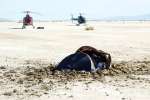 Genesis Missions Hard Impact
5.07.2009
A flying saucer from outer space crash-landed in the Utah desert in 2004 after being tracked by radar and chased by helicopters. No space aliens were involved, however. The saucer, pictured above, was the Genesis sample return capsule, part of a human-made robot Genesis spaceship launched in 2001 by NASA itself to study the Sun.
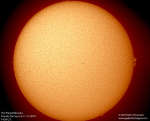 Mercury and the Quiet Sun
14.11.2019
On November 11, 2019 the Sun was mostly quiet, experiencing a minimum in its 11 year cycle of activity. In fact, the only spot visible was actually planet Mercury, making a leisurely 5 1/2 hour transit in front of the calm solar disk.
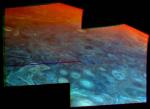 Hazing Jupiter
9.01.1997
A dramatic mosaic of recent images from the Galileo spacecraft reveals details of swirling clouds and a thick stratospheric haze in the atmosphere of Jupiter, the Solar System's largest planet. This false color...
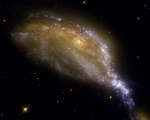 A Galaxy Collision in NGC 6745
30.09.2012
Galaxies don't normally look like this. NGC 6745 actually shows the results of two galaxies that have been colliding for only hundreds of millions of years. Just off the above digitally sharpened photograph to the lower right is the smaller galaxy, moving away.
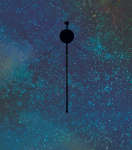 Interstellar Voyager
9.09.2022
Voyager 1 and Voyager 2 were launched in 1977 on a grand tour of the outer planets of the Solar System. They have become the longest operating and most distant spacecraft from Earth. Both have traveled beyond the heliosphere, the realm defined by the influence of the solar wind and the Sun's magnetic field.
 APOD: 2024 September 2 Б A Triangular Prominence Hovers Over the Sun
2.09.2024
Why is there a triangle hovering over the Sun? Although the shape is unusual, the type of structure is not: it is part of an evolving solar prominence. Looping magnetic fields on the Sun channel the flow of energetic particles, sometimes holding glowing gaseous structures aloft for months.
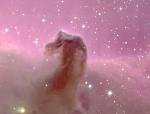 The Horsehead Nebula
16.12.2001
One of the most identifiable nebulae in the sky, the Horsehead Nebula in Orion, is part of a large, dark, molecular cloud. Also known as Barnard 33, the unusual shape was first discovered on a photographic plate in the late 1800s.
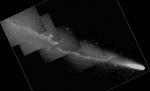 Comet Ikeya-Zhangs Busy Tail
18.03.2002
One of the brightest comets of the past five years will likely reach its peak brightness this week. Comet Ikeya-Zhang, officially known as C/2002 C1, can now be seen without aide from a dark location above the western horizon shortly after sunset.
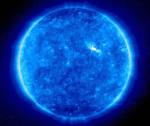 Blue Sun Glaring
6.01.1997
The Sun is a bubbling ball of extremely hot gas. In this false-color picture, light blue regions are extremely hot - over 1 million degrees, while dark blue regions are slightly cooler. The camera filter used was highly sensitive to the emission of highly charged iron ions, which trace the magnetic field of the Sun.
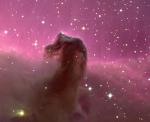 The Horsehead Nebula
19.05.1999
One of the most identifiable nebulae in the sky, the Horsehead Nebula in Orion, is part of a large, dark, molecular cloud. Also known as Barnard 33, the unusual shape was first discovered on a photographic plate in the late 1800s.
|
January February March April May June July August September October |
|||||||||||||||||||||||||||||||||||||||||||||||||