
|
You entered: magellanic clouds
 The Large Cloud of Magellan
7.09.2023
The 16th century Portuguese navigator Ferdinand Magellan and his crew had plenty of time to study the southern sky during the first circumnavigation of planet Earth. As a result, two fuzzy cloud-like objects easily...
 NGC 2419 Intergalactic Wanderer
4.06.2015
Three objects stand out in this thoughtful telescopic image, a view toward the mostly stealthy constellation Lynx. The two brightest (the spiky ones) are nearby stars. The third is the remote globular star cluster NGC 2419, at distance of nearly 300,000 light-years.
 APOD: 2024 July 17 Б Villarrica Volcano Against the Sky
17.07.2024
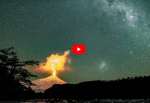
When Vulcan, the Roman god of fire, swings his blacksmith's hammer, the sky is lit on fire. A recent eruption of Chile's Villarrica volcano shows the delicate interplay between this fire -- actually...
 Milky Way and Zodiacal Light over Chile
9.03.2020
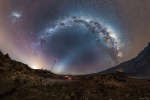
What is the band of light connecting the ground to the Milky Way? Zodiacal light -- a stream of dust that orbits the Sun in the inner Solar System. It is most easily seen just before sunrise, where it has been called a false dawn, or just after sunset.
 The Tarantula Zone
26.04.2008
The Tarantula Nebula is more than 1,000 light-years in diameter -- a giant star forming region within our neighboring galaxy the Large Magellanic Cloud (LMC). That cosmic arachnid lies at the upper left of this expansive mosiac covering a part of the LMC over 6,000 light-years across.
 The Tarantula Zone
16.09.2009
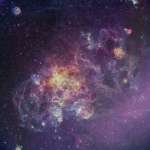
The Tarantula Nebula is more than 1,000 light-years in diameter -- a giant star forming region within our neighboring galaxy the Large Magellanic Cloud (LMC). That cosmic arachnid lies left of center in this in this colorful telescopic image taken through narrow-band filters. It covers a part of the LMC over 2,000 light-years across.
 From the Northern to the Southern Cross
27.01.2014
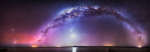
There is a road that connects the Northern to the Southern Cross but you have to be at the right place and time to see it. The road, as pictured above, is actually...
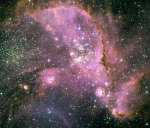 Young Stars of NGC 346
12.05.2022
The massive stars of NGC 346 are short lived, but very energetic. The star cluster is embedded in the largest star forming region in the Small Magellanic Cloud, some 210,000 light-years distant. Their...
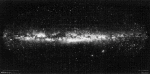 7,000 Stars and the Milky Way
17.05.1997
This panorama view of the sky is really a drawing. It was made in the 1940s under the supervision of astronomer Knut Lundmark at the Lund Observatory in Sweden. To create the picture, draftsmen...
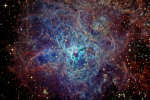 The Cosmic Web of the Tarantula Nebula
11.11.2008
First cataloged as a star, 30 Doradus is actually an immense star forming region in nearby galaxy The Large Magellanic Cloud. The region's spidery appearance is responsible for its popular name, the Tarantula nebula, except that this tarantula is about 1,000 light-years across, and 180,000 light-years away in the southern constellation Dorado.
|
January February March April May June July August September |
|||||||||||||||||||||||||||||||||||||||||||||||||