
|
You entered: gravity
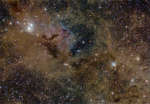 Stardust in Perseus
10.10.2015
This cosmic expanse of dust, gas, and stars covers some 6 degrees on the sky in the heroic constellation Perseus. At upper left in the gorgeous skyscape is the intriguing young star cluster IC 348 and neighboring Flying Ghost Nebula.
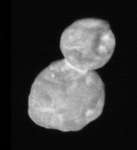 Ultima and Thule
3.01.2019
On January 1 New Horizons encountered the Kuiper Belt object nicknamed Ultima Thule. Some 6.5 billion kilometers from the Sun, Ultima Thule is the most distant world ever explored by a spacecraft from Earth.
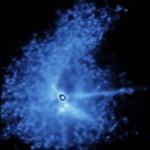 The T Tauri Star Forming System
4.06.2001
What did the Sun look like before there were planets? A prototype laboratory for the formation of low mass stars like our Sun is the T Tauri system, one of the brighter star systems toward the constellation of Taurus. In young systems, gravity causes a gas cloud to condense.
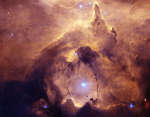 A Massive Star in NGC 6357
21.11.2010
For reasons unknown, NGC 6357 is forming some of the most massive stars ever discovered. One such massive star, near the center of NGC 6357, is framed above carving out its own interstellar castle with its energetic light from surrounding gas and dust.
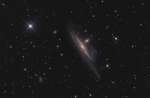 Galaxies in the River
10.02.2016
Large galaxies grow by eating small ones. Even our own galaxy practices galactic cannibalism, absorbing small galaxies that get too close and are captured by the Milky Way's gravity. In fact, the practice...
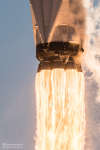 TESS Launch Close Up
21.04.2018
NASA's Transiting Exoplanet Survey Satellite (TESS) began its search for planets orbiting other stars by leaving planet Earth on April 18. The exoplanet hunter rode to orbit on top of a Falcon 9 rocket.
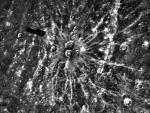 Degas Ray Crater on Mercury
16.12.2000
Like the Earth's Moon, Mercury is scarred with craters testifying to an intense bombardment during the early history of the Solar System. In 1974, the Mariner 10 spacecraft surveyed this innermost planet up close, producing the only detailed images of its tortured surface.
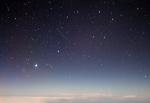 Aurigids from 47 000 Feet
5.09.2007
On September 1, Aurigid meteors filled the sky, in keeping with inovative predictions of an outburst from this historically tentative meteor shower. Astronomers flying at 47,000 feet on a dedicated mission to observer the outburst collected image data for this composite photo of the Aurigids' bright and colorful streaks.
 A Massive Star in NGC 6357
22.10.2013
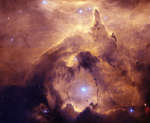
For reasons unknown, NGC 6357 is forming some of the most massive stars ever discovered. One such massive star, near the center of NGC 6357, is framed above carving out its own interstellar castle with its energetic light from surrounding gas and dust.
 Galaxies in the River
10.05.2018
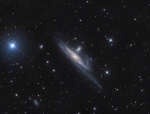
Large galaxies grow by eating small ones. Even our own galaxy practices galactic cannibalism, absorbing small galaxies that get too close and are captured by the Milky Way's gravity. In fact, the practice...
|
January February March April May June July August September |
|||||||||||||||||||||||||||||||||||||||||||||||||