
|
You entered: evening sky
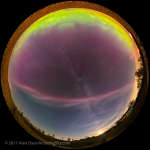 All Sky Steve
14.10.2017
Familiar green and red tinted auroral emission floods the sky along the northern (top) horizon in this fish-eye panorama projection from September 27. On the mild, clear evening the Milky Way tracks through the zenith of a southern Alberta sky and ends where the six-day-old Moon sets in the southwest.
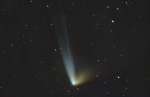 Comet Tails and Star Trails
21.07.2015
After grazing the western horizon on northern summer evenings Comet PanSTARRS (also known as C/2014 Q1) climbed higher in southern winter skies. A visitor to the inner Solar System discovered in August 2014 by the prolific panSTARRS survey, the comet was captured here on July 17.
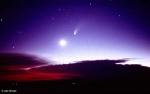 Hale-Bopp: The Crowd Pleaser Comet
9.07.1998
In 1997, the bright comet Hale-Bopp may have become the most viewed comet in history -- visible even to casual skywatchers in light polluted cities around the globe. In this picture, taken by photographer...
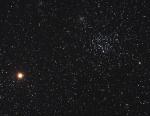 Mars and the Star Clusters
19.04.2006
This evening's skyscape includes a view similar to this one, recorded in western skies on April 16 - an orange-hued planet Mars wandering near rich open star cluster M35. Also notable is fainter star cluster NGC 2158, just above and left of M35.
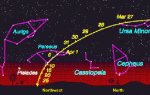 Comet Hyakutake Finder Chart for Early April
31.03.1996
During April Comet Hyakutake heads in toward the Sun after passing the Earth. At this time the comet's orbit places it north of the Earth. Remaining visible in the northern sky as it nears the Sun, it will set progressively earlier in the evening.
 Three Planets in Dawn Skies
9.12.2006
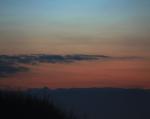
Three children of the Sun rise in the east in this peaceful dawn skyview recorded December 7th near Bolu, Turkey. Inner planet Mercury, fresh from its second transit of the 21st century, stands highest in the bright sky at the top right. Gas giant Jupiter lies below the cloud bank near picture center.
 Venus and Jupiter at Dawn
21.08.2014
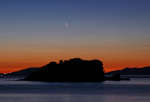
On Monday morning, Venus and Jupiter gathered close in dawn skies, for some separated by about half the width of a full moon. It was their closest conjunction since 2000, captured here above the eastern horizon before sunrise.
 Mercury and Jupiter at Sunset
18.03.2011
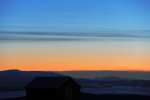
When warm sunset hues begin to fade, two celestial beacons now shine in the evening twilight, Mercury and Jupiter. Wandering away from the Sun in planet Earth's sky, Mercury will offer good views this month as spring approaches in the northern hemisphere where the ecliptic plane makes a steep angle with the western horizon.
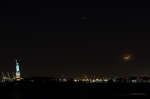 New York Harbor Moonset
6.01.2017
Moonset on January 1 is captured in this sea and night sky snapshot from the port city of New York. Its warm moonlight shining through haze and thin clouds, this New Year's Moon was about 3 days old, in a waxing crescent phase. The visible lunar disk is about 10 percent illuminated.
 APOD: 2025 August 30 Б A Two Percent Moon
30.08.2025
A young crescent moon can be hard to see. That's because when the Moon shows it's crescent phase (young or old) it can never be far from the Sun in planet Earth's sky.
|
January February |
|||||||||||||||||||||||||||||||||||||||||||||||||