
|
You entered: TRACE
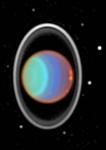 Uranian Moons, Rings, And Clouds
26.11.1997
The giant planet Uranus is faint and featureless when viewed in visible light. But this pair of near-infrared mosaics from the Hubble Space Telescope's NICMOS camera reveals moons, rings, and clouds of this distant gas planet.
 Analemma of the Moon
13.07.2005
An analemma is that figure-8 curve you get when you mark the position of the Sun at the same time each day for one year. But the trick to imaging an analemma...
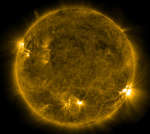 Equinox and the Iron Sun
23.09.2010
Today, the Sun crosses the celestial equator heading south at 03:09 Universal Time. Known as an equinox, this astronomical event marks the first day of autumn in the northern hemisphere and spring in the south. Equinox means equal night.
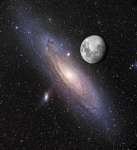 Moon Over Andromeda
1.08.2013
The Great Spiral Galaxy in Andromeda (aka M31), a mere 2.5 million light-years distant, is the closest large spiral to our own Milky Way. Andromeda is visible to the unaided eye as a small...
 Bright Nebulae in M33
17.10.2009
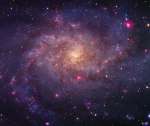
Gorgeous spiral galaxy M33 seems to have more than its fair share of bright emission nebulae. In fact, narrow-band and broad-band image data are combined in this beautifully detailed composite to trace the reddish emission nebulae, star forming HII regions, sprawling along loose spiral arms that wind toward the galaxy's core.
 Simeis 147: Supernova Remnant
25.04.2016
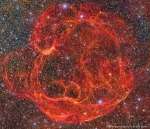
It's easy to get lost following the intricate strands of the Spaghetti Nebula. A supernova remnant cataloged as Simeis 147 and Sh2-240, the glowing gas filaments cover nearly 3 degrees -- 6 full moons -- on the sky. That's about 150 light-years at the stellar debris cloud's estimated distance of 3,000 light-years.
 Grand Spiral NGC 5643
26.12.2024
Viewed face-on, grand spiral galaxy NGC 5643 has a festive appearance in this colorful cosmic portrait. Some 55 million light-years distant, the galaxy extends for over 100,000 light-years, seen within the boundaries of the southern constellation Lupus.
 APOD: 2024 December 31 Б The Twisted Disk of NGC 4753
31.12.2024
What do you think this is? HereБs a clue: it's bigger than a bread box. Much bigger. The answer is that pictured NGC 4753 is a twisted disk galaxy, where unusual dark dust filaments provide clues about its history.
 Trailing Planets
10.05.2002
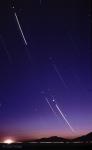
Positioning his camera and tripod on planet Earth, near Maricopa, Arizona, USA, astrophotographer Joe Orman created this trailing display of the ongoing sky-full-of-planets on May 3rd. He initially captured the grouping in a 20 second long time exposure recording the positions of the bright planets and stars.
 Pantheon Earth and Moon
20.04.2007
Could this be a picture of the Earth and Moon from space? It certainly looks like it at first glance, with a dark, cratered Moon standing off from planet Earth's lovely blue disk surrounded by a nurturing atmosphere. In fact, this view looks up into the dome of the ancient Pantheon in Rome.
|
January February March April May June July August September |
|||||||||||||||||||||||||||||||||||||||||||||||||