
|
You entered: NEAR project
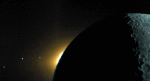 The Ecliptic Plane
21.09.1996
The Plane of the Ecliptic is illustrated in this Clementine star tracker camera image which reveals (from right to left) the Moon lit by Earthshine, the Sun's corona rising over the Moon's dark limb, and the planets Saturn, Mars, and Mercury.
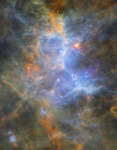 Herschel s Eagle Nebula
28.07.2016
A now famous picture from the Hubble Space Telescope featured Pillars of Creation, star forming columns of cold gas and dust light-years long inside M16, the Eagle Nebula. This false-color composite image views...
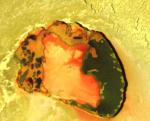 Looking Into an Io Volcano
27.03.2002
What would it look like to peer into one of the volcanoes currently active on Jupiter's moon Io? The caldera of Tupan Patera, named after a Brazilian thunder god, reveals itself...
 Up Close to Jupiter's Moon Io
7.06.2000
Above is the highest resolution photograph yet taken of the Solar System's strangest moon. The surface of Jupiter's moon Io is home to violent volcanoes that are so active they turn the entire moon inside out. The above photograph shows a region four kilometers across and resolves features only five meters across.
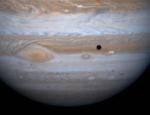 Jupiter, Io, and Shadow
7.12.2002
Pictured above is the innermost of Jupiter's Galilean satellites, Io, superposed in front of the gas giant planet. To the left of Io is a dark spot that is Io's own shadow. A solar eclipse would be seen from within the shadow spot on Jupiter.
 The Dunes Of Mars
14.08.1998
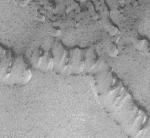
The North Pole of Mars is ringed by a "sea of sand dunes". For Mars' Northern Hemisphere, Spring began in mid July and increased sunlight is now shrinking the polar cap revealing the wind-swept dunes to the cameras onboard the Mars Global Surveyor spacecraft.
 The Ecliptic Plane
14.10.2000
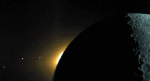
The Plane of the Ecliptic is well illustrated in this picture from the 1994 lunar prospecting Clementine spacecraft. Clementine's star tracker camera image reveals (from right to left) the Moon lit by Earthshine, the Sun's corona rising over the Moon's dark limb, and the planets Saturn, Mars, and Mercury.
 Perihelion Sun
11.01.1999
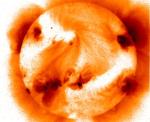
The Earth's orbit is not a perfect, sun-centered circle. At aphelion, the most distant point in Earth's orbit, the Sun is 150 million kilometers away and at perihelion, the closest point, Earth approaches the Sun to within about 147 million kilometers. While aphelion occurs in July, perihelion for planet Earth comes in January.
 Coronal Rain, Solar Storm
15.11.2000
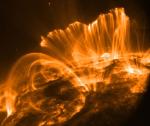
In this picture, the Sun's surface is quite dark. A frame from a movie recorded on November 9th by the orbiting TRACE telescope, it shows coronal loops lofted over a solar active region.
 Neptune's Great Dark Spot: Gone But Not Forgotten
8.05.1996
When NASA's Voyager 2 spacecraft flew by distant Neptune in August of 1989, astronomers were shocked. Since Neptune receives only 3 percent the sunlight Jupiter does, they expected to find a dormant, dark, frigid planet. Instead, the Voyager images revealed evidence of a dynamic and turbulent world.
|
January February March April May June July August September |
|||||||||||||||||||||||||||||||||||||||||||||||||