
|
You entered: Jupiter's Moons
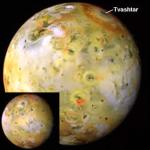 A Newly Active Volcano On Jupiters Io
16.10.2001
Would a volcano plume discovered in January above Jupiter's Moon Io still be active months later? To answer this question, the robot spacecraft Galileo currently in orbit around Jupiter was maneuvered to image the plume site during its recent flyby of Io in August.
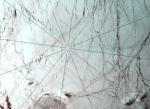 North Pole Below
20.10.2000
Orbiting over the north pole of planet Earth on May 5, the MODIS instrument on-board the Terra spacecraft, recorded this view of the ice cap 700 kilometers below. A radial grid centered on the pole is shown on top of the approximately true color image where each pixel covers about one square kilometer.
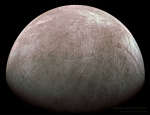 Jupiters Europa from Spacecraft Juno
3.10.2022
What mysteries might be solved by peering into this crystal ball? In this case, the ball is actually a moon of Jupiter, the crystals are ice, and the moon is not only dirty but cracked beyond repair. Nevertheless, speculation is rampant that oceans exist under Europa's fractured ice-plains that could support life.
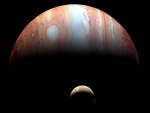 A Jupiter Io Montage from New Horizons
8.01.2008
As the New Horizons spacecraft sweeps through the Solar System, it is taking breathtaking images of the planets. In February of last year, New Horizons passed Jupiter and the ever-active Jovian moon Io. In this montage, Jupiter was captured in three bands of infrared light making the Great Red Spot look white.
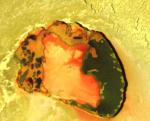 Looking Into an Io Volcano
27.03.2002
What would it look like to peer into one of the volcanoes currently active on Jupiter's moon Io? The caldera of Tupan Patera, named after a Brazilian thunder god, reveals itself...
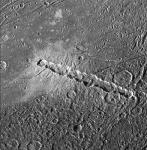 Ganymede: Torn Comet Crater Chain
5.08.1998
This remarkable line of 13 closely spaced craters on Jupiter's moon Ganymede was photographed by the Galileo spacecraft in 1997. The picture covers an area about 120 miles wide and the chain of craters cuts across a sharp boundary between dark and light terrain. What caused this crater chain?
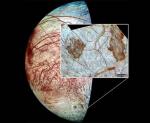 Galileo s Europa
19.09.2003
Launched in 1989 and looping through the jovian system since late 1995, the voyage of NASA's Galileo spacecraft will soon come to an end. The spacecraft has been targeted to plunge directly into Jupiter this Sunday, September 21st, at about 30 miles per second.
 Ganymede: Torn Comet Crater Chain
15.12.2001
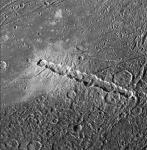
This striking line of 13 closely spaced craters on Jupiter's moon Ganymede was photographed by the Galileo spacecraft in 1997. The picture covers an area about 120 miles wide and the chain of craters cuts across a sharp boundary between dark and light terrain. What caused this crater chain?
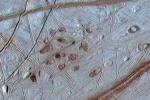 Europa s Freckles
1.11.2002
Europa, one of Jupiter's large Galilean moons, may well posses an ocean of liquid water hidden beneath its icy surface -- and so holds the tantalizing possibility of life. In this image, constructed with...
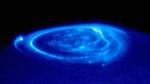 A Close Up of Aurora on Jupiter
19.12.2000
Jupiter has aurorae. Like Earth, the magnetic field of the gas giant funnels charged particles released from the Sun onto the poles. As these particles strike the atmosphere, electrons are temporarily knocked away from existing gas molecules. Electric force attracts these electrons back. As the electrons recombine to remake neutral molecules, auroral light is emitted.
|
January February March April May June July August September |
|||||||||||||||||||||||||||||||||||||||||||||||||