
|
You entered: planets
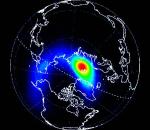 X-Ray Earth
16.09.2000
Above is a picture of the Earth in x-rays, taken in March of 1996 from the orbiting Polar satellite. Most of the planet is dark with superposed continent and coordinate grids, while the bright x-ray emission near the north pole is shown in red. Why does the Earth have an x-ray glow?
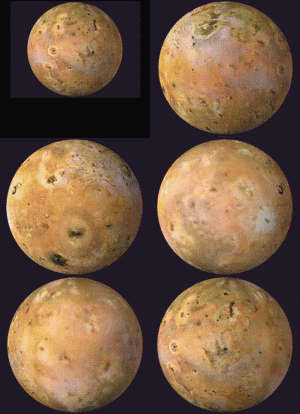 Io Rotating
24.10.2000
The surface of Io is continually changing. Jupiter's moon is the home to many powerful volcanoes so active they are effectively turning the moon inside out. The above time-lapse sequence is a composite of images taken during two space missions that approached the violent moon: Voyager and Galileo.
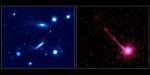 PKS 1127 145: Quasar View
8.02.2002
The quasar known as PKS 1127-145 lies ten billion light-years from our fair planet. A Hubble Space Telescope view in the left panel shows this quasar along with other galaxies as they appear in optical light. The quasar itself is the brightest object in the lower right corner.
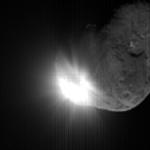 Thirteen Seconds After Impact
5.07.2005
Fireworks came early on July 4th when, at 1:52am EDT, the Deep Impact spacecraft's probe smashed into the surface of Comet Tempel 1's nucleus at ten kilometers per second. The well-targeted impactor probe was vaporized as it blasted out an expanding cloud of material, seen here 13 seconds after the collision.
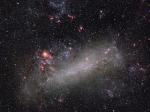 The Large Cloud of Magellan
10.05.2006
Portuguese navigator Fernando de Magellan and his crew had plenty of time to study the southern sky during the first circumnavigation of planet Earth. As a result, two fuzzy cloud-like objects easily visible for southern hemisphere skygazers are known as the Clouds of Magellan.
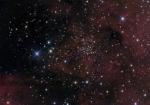 Tombaugh 4
21.10.2006
Clyde Tombaugh discovered planet Pluto in 1930 while surveying the skies with the 13-inch Lawrence Lowell Telescope. But the skilled and careful astronomer also went on to discover star clusters, comets, asteroids, and clusters of galaxies. For example, pictured is galactic or open star cluster Tombaugh 4 in the northern constellation Cassiopeia.
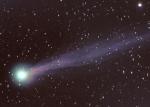 Comet SWAN Outburst
28.10.2006
Near its closest approach to planet Earth, comet SWAN (C/2006 M4) brightened unexpectedly earlier this week, becoming visible to naked-eye observers under dark night skies. Telescopic observers also noticed dramatic changes in the comet's colorful coma and tail, seen in this view recorded on October 25th.
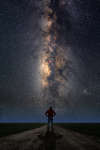 The Milky Road
13.06.2009
Inspired by the night skies of planet Earth in the International Year of Astronomy, photographer Larry Landolfi created this tantalizing fantasy view. The composited image suggests a luminous Milky Way is the heavenly extension of a country road.
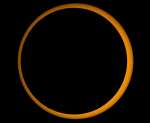 Annular Solar Eclipse
19.05.2012
Tomorrow, May 20, the Moon's shadow will race across planet Earth. Observers within the 240-300 kilometer wide shadow track will be able to witness an annular solar eclipse as the Moon's apparent size is presently too small to completely cover the Sun.
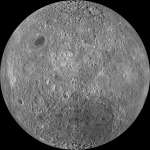 Lunar Farside
5.04.2014
Tidally locked in synchronous rotation, the Moon always presents its familiar nearside to denizens of planet Earth. From lunar orbit, the Moon's farside can become familiar, though. In fact this sharp picture, a mosaic from the Lunar Reconnaissance Orbiter's wide angle camera, is centered on the lunar farside.
|
January February |
|||||||||||||||||||||||||||||||||||||||||||||||||