
|
You entered: nearest stars
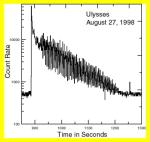 SGR 1900+14 : Magnetar
3.09.1998
On August 27th an intense flash of X-rays and gamma-rays swept through our Solar System. Five spacecraft of the Third InterPlanetary gamma-ray burst Network, Ulysses, WIND, RXTE, NEAR, and BeppoSAX, recorded the high energy...
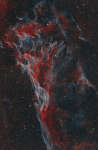 Williamina Fleming s Triangular Wisp
10.11.2017
Chaotic in appearance, these tangled filaments of shocked, glowing gas are spread across planet Earth's sky toward the constellation of Cygnus as part of the Veil Nebula. The Veil Nebula itself is a large supernova remnant, an expanding cloud born of the death explosion of a massive star.
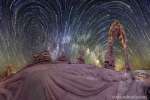 Warped Sky: Star Trails over Arches National Park
17.03.2014
What's happened to the sky? A time warp, of sorts, and a digital space warp too. The time warp occurs because this image captured in a single frame a two and a half hour exposure of the night sky. As a result, prominent star trails are visible.
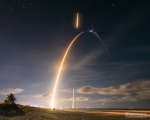 Launch and Landing
13.01.2018
A composite of three consecutive exposures, this night skyscape follows the January 7 launch and first stage landing of a Falcon 9 rocket from a beach on planet Earth's space coast. With...
 APOD: 2023 December 20 Б Ice Halos over Bavaria
20.12.2023
What's causing those unusual sky arcs? Ice crystals. While crossing a field of fresh snow near Fцssen, Bavaria, Germany, earlier this month, the photographer noticed that he had entered an ice fog.
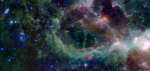 Galaxies Beyond the Heart: Maffei 1 and 2
9.03.2010
The two galaxies on the far left were unknown until 1968. Although they would have appeared as two of the brighter galaxies on the night sky, the opaque dust of the central band of our Milky Way Galaxy had obscured them from being seen in visible light.
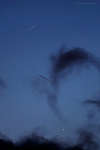 Clouds and Crescents
4.01.2014
A crescent Venus shines along the western horizon at dusk in this clearing sky. The Earth's sister planet is smiling between the low clouds near the bottom of the frame during its January 2nd conjunction with the slender, young crescent Moon above.
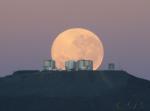 Paranal Moonset
4.11.2006
Just before the rising Sun fully illuminated the 2,635 meter summit of Cerro Paranal in northern Chile, Gordon Gillet captured this stunning moonset. In the telephoto picture, a nearly full October Moon is silhouetting the impressive array of telescopes at ESO's Paranal Observatory.
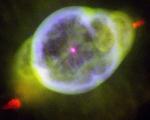 NGC 3242: The Ghost of Jupiter
29.10.2005
After a star like the Sun completes fusion in its core, it throws off its outer layers in a brief, beautiful cosmic display called a planetary nebula. NGC 3242 is such a planetary nebula, with the stellar remnant white dwarf star visible at the center.
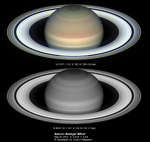 Saturn at Opposition
29.05.2015
Telescopic observers on Earth have been treated to spectacular views of Saturn lately as the ringed planet reached its 2015 opposition on May 23 at 0200 UT. Of course opposition means opposite the Sun in Earth's sky. So near opposition Saturn is up all night, at its closest and brightest for the year.
|
January February March April May June July August September October |
|||||||||||||||||||||||||||||||||||||||||||||||||