
|
You entered: clouds
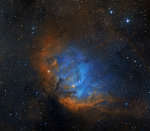 The Tulip in the Swan
20.10.2016
Framing a bright emission region this telescopic view looks out along the plane of our Milky Way Galaxy toward the nebula rich constellation Cygnus the Swan. Popularly called the Tulip Nebula, the glowing cloud of interstellar gas and dust is also found in the 1959 catalog by astronomer Stewart Sharpless as Sh2-101.
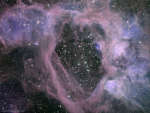 The N44 Superbubble
25.06.2017
What created this gigantic hole? The vast emission nebula N44 in our neighboring galaxy the Large Magellanic Cloud has a large, 250 light-year hole and astronomers are trying to figure out why. One possibility is particle winds expelled by massive stars in the bubble's interior that are pushing out the glowing gas.
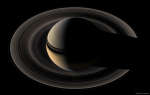 Crescent Saturn
8.08.2020
From Earth, Saturn never shows a crescent phase. But when viewed from a spacecraft the majestic giant planet can show just a sunlit slice. This image of crescent Saturn in natural color was taken by the robotic Cassini spacecraft in 2007.
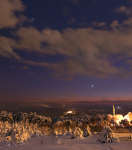 Three Planets and a Comet
23.12.2021
Are you still looking for that perfect holiday gift for an astronomer? If your night sky is dark and horizon clear enough, the Solar System may have done your shopping for you. Send them outside after sunset to see three planets and a comet.
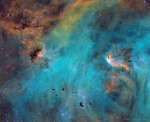 Stars and Globules in the Running Chicken Nebula
19.04.2022
The eggs from this gigantic chicken may form into stars. The featured emission nebula, shown in scientifically assigned colors, is cataloged as IC 2944 but known as the Running Chicken Nebula for the shape of its greater appearance. Seen toward the bottom of the image are small, dark molecular clouds rich in obscuring cosmic dust.
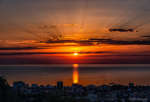 September Sunrise Shadows
24.09.2022
The defining astronomical moment for this September's equinox was on Friday, September 23, 2022 at 01:03 UTC, when the Sun crossed the celestial equator moving south in its yearly journey through planet Earth's sky.
 The Great Carina Nebula
19.04.2024
A jewel of the southern sky, the Great Carina Nebula is more modestly known as NGC 3372. One of our Galaxy's largest star forming regions, it spans over 300 light-years. Like the smaller, more northerly Great Orion Nebula, the Carina Nebula is easily visible to the unaided eye.
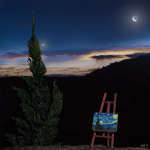 APOD: 2026 June 19 Б Starry Night II
19.06.2026
Does this scene look familiar? It is a modern recreation of the famous painting Starry Night by Vincent van Gogh. Both the image and the painting depict a tall tree on the left...
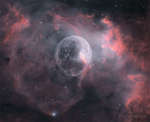 APOD: 2026 July 27 Б NGC 7635: The Bubble Nebula
27.07.2026
What created this huge space bubble? Blown by the wind from a star, this tantalizing, head-like apparition is cataloged as NGC 7635, but known simply as the Bubble Nebula. Taken from Krakow, Poland, the featured view utilizes a long exposure to reveal the intricate details of this cosmic bubble and its environment.
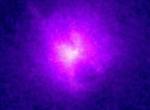 Hot Gas In Hydra A
17.12.1999
The Hydra A galaxy cluster is really big. In fact, such clusters of galaxies are the largest gravitationally bound objects in the Universe. But individual galaxies are too cool to be recorded in this false-color Chandra Observatory X-ray image which shows only the 40 million degree gas that permeates the Hydra A cluster.
|
January February March April May June July August September |
|||||||||||||||||||||||||||||||||||||||||||||||||