
|
You entered: telescope
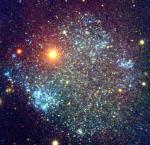 Sextans A: A Seemingly Square Galaxy
3.11.1998
What's bothering local galaxy Sextans A? A small dwarf irregular galaxy spanning 5 thousand light years across, Sextans A is located only 5 million light-years away. Named for its home constellation of Sextans, the "diamond in the rough" structure relates to an ancient unknown event.
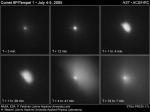 Deep Impact on Comet Tempel 1 from Hubble
18.07.2005
It was a human-made event visible across the Solar System. At the direction of terrestrial scientists, a refrigerator-sized probe from the Deep Impact mission struck Comet Tempel 1 on July 4 at over 35,000 kilometers per hour.
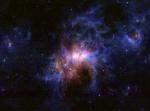 Dusty Environs of Eta Carinae
15.10.2005
Eta Car is a massive star, but it's not as bright as it used to be. Now only easily visible in binoculars or a small telescope, Eta Carinae has a history of spectacular flaring and fading behavior.
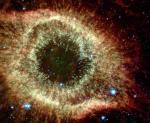 Infrared Helix
12.01.2006
Over six hundred light years from Earth, in the constellation Aquarius, a sun-like star is dying. Its last few thousand years have produced the Helix Nebula (NGC 7293), a well studied and nearby example of a Planetary Nebula, typical of this final phase of stellar evolution.
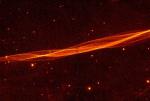 Filaments In The Cygnus Loop
26.04.2000
Subtle and delicate in appearance, these are filaments of shocked interstellar gas -- part of the expanding blast wave from a violent stellar explosion. Recorded in November 1997 with the Wide Field and Planetary Camera 2 onboard the Hubble Space Telescope, the picture is a closeup of a supernova remnant known as the Cygnus Loop.
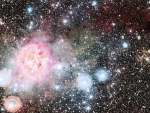 The Cocoon Nebula from CFHT
14.01.2008
What creates the colors of the Cocoon Nebula? The Cocoon Nebula, cataloged as IC 5146, is a strikingly beautiful nebula located about 4,000 light years away toward the constellation of the Swan (Cygnus). Inside the Cocoon Nebula is a newly developing open cluster of stars.
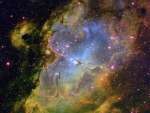 Inside the Eagle Nebula
8.02.2009
From afar, the whole thing looks like an Eagle. A closer look at the Eagle Nebula, however, shows the bright region is actually a window into the center of a larger dark shell of dust. Through this window, a brightly-lit workshop appears where a whole open cluster of stars is being formed.
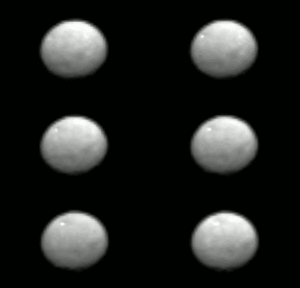 Approaching Asteroid Ceres
19.01.2015
It is the largest asteroid in the asteroid belt -- what secrets does it hold? To find out, NASA has sent the robotic Dawn spacecraft to explore and map this cryptic 1,000-kilometer wide world: Ceres. Orbiting between Mars and Jupiter, Ceres is officially categorized as a dwarf planet but has never been imaged in detail.
 Trio Leo
9.05.2015
This popular group is famous as the Leo Triplet - a gathering of three magnificent galaxies in one field of view. Crowd pleasers when imaged with even modest telescopes, they can be introduced individually as NGC 3628 (left), M66 (bottom right), and M65 (top).
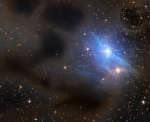 Reflections on vdB 31
11.03.2017
Riding high in the constellation of Auriga, beautiful, blue vdB 31 is the 31st object in Sidney van den Bergh's 1966 catalog of reflection nebulae. It shares this well-composed celestial still life with dark, obscuring clouds recorded in Edward E. Barnard's 1919 catalog of dark markings in the sky.
|
January February March April May |
|||||||||||||||||||||||||||||||||||||||||||||||||