
|
You entered: rings
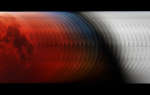 Into the Shadow
24.01.2020
On January 21, 2019 moonwatchers on planet Earth saw a total lunar eclipse. In 35 frames this composite image follows the Moon that night as it crossed into Earth's dark umbral shadow. Taken...
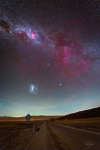 The Gum Nebula Supernova Remnant
29.11.2022
Because the Gum Nebula is the closest supernova remnant, it is actually hard to see. Spanning 40 degrees across the sky, the nebula appears so large and faint that it is easily lost in the din of a bright and complex background.
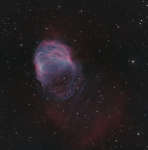 The Medusa Nebula
17.03.2023
Braided and serpentine filaments of glowing gas suggest this nebula's popular name, The Medusa Nebula. Also known as Abell 21, this Medusa is an old planetary nebula some 1,500 light-years away in the constellation Gemini. Like its mythological namesake, the nebula is associated with a dramatic transformation.
 APOD: 2024 June 5 Б Shadow of a Martian Robot
5.06.2024
What if you saw your shadow on Mars and it wasn't human? Then you might be the Perseverance rover exploring Mars. Perseverance has been examining the Red Planet since 2021, finding evidence of its complex history of volcanism and ancient flowing water, and sending breathtaking images across the inner Solar System.
 APOD: 2024 August 14 Б Meteors and Aurora over Germany
14.08.2024
This was an unusual night. For one thing, the night sky of August 11 and 12, earlier this week, occurred near the peak of the annual Perseid Meteor Shower. Therefore, meteors streaked across the dark night as small bits cast off from Comet Swift-Tuttle came crashing into the Earth's atmosphere.
 APOD: 2024 September 8 Б M31: The Andromeda Galaxy
8.09.2024
The most distant object easily visible to the unaided eye is M31, the great Andromeda Galaxy. Even at some two and a half million light-years distant, this immense spiral galaxy -- spanning over 200,000 light years -- is visible, although as a faint, nebulous cloud in the constellation Andromeda.
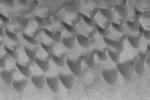 Sand Dunes on Mars
26.02.2001
Sand dunes on Mars can appear exotic. The dark dunes above might be compared to shark's teeth or chocolate confections. In reality, they arise from the complex relationship between the sandy surface and high winds on Mars.
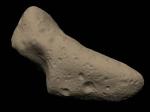 Asteroid Eros Reconstructed
5.06.2001
Orbiting the Sun between Mars and Earth, asteroid 433 Eros was visited by the robot spacecraft NEAR-Shoemaker in 2000 February. Some of the 100,000+ images taken by NEAR of the tumbling space rock have been combined into the above high-resolution composite.
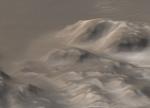 Frosty Mountains on Mars
30.07.2003
What causes the unusual white color on some Martian mountains? The answer can be guessed by noticing that the bright areas disappear as springtime takes hold in the south of Mars: dry ice. Unlike water ice, dry carbon dioxide ice sublimates directly to gas from its frozen state.
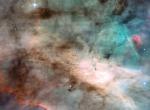 In the Center of the Omega Nebula
8.02.2004
In the depths of the dark clouds of dust and molecular gas known as the Omega Nebula, stars continue to form. The above image from the Hubble Space Telescope's Advanced Camera for Surveys shows exquisite detail in the famous star-forming region.
|
January February March April May |
|||||||||||||||||||||||||||||||||||||||||||||||||