
|
You entered: image
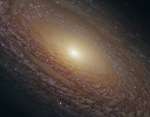 Spiral Galaxy NGC 2841 Close Up
18.02.2011
A mere 46 million light-years distant, spiral galaxy NGC 2841 can be found in the northern constellation of Ursa Major. This sharp view of the gorgeous island universe shows off a striking yellow nucleus and galactic disk.
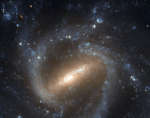 Barred Spiral Galaxy NGC 1073
20.02.2012
Many spiral galaxies have bars across their centers. Even our own Milky Way Galaxy is thought to have a modest central bar. Prominently barred spiral galaxy NGC 1073, pictured above, was captured in spectacular detail in this recently released image taken by the orbiting Hubble Space Telescope.
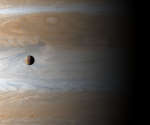 Io: Moon Over Jupiter
8.04.2012
How big is Jupiter's moon Io? The most volcanic body in the Solar System, Io (usually pronounced "EYE-oh") is 3,600 kilometers in diameter, about the size of planet Earth's single large natural satellite.
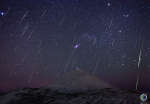 Geminid Meteors over Teide Volcano
17.12.2013
On some nights it rains meteors. Peaking two nights ago, asteroid dust streaked through the dark skies of Earth, showering down during the annual Geminids meteor shower. Astrophotographer Juan Carlos Casado captured the space weather event, as pictured above, in a series of exposures spanning about 2.3 hours using a wide angle lens.
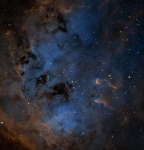 The Tadpoles of IC 410
9.01.2014
This telescopic close-up shows off the otherwise faint emission nebula IC 410 in striking false-colors. It also features two remarkable inhabitants of the cosmic pond of gas and dust below and right of center, the tadpoles of IC 410. The picture is a composite of images taken through narrow band filters.
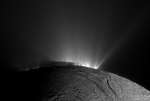 Shadows and Plumes Across Enceladus
4.08.2014
Why does Enceladus have ice plumes? The discovery of jets spewing water vapor and ice was detected by the Saturn-orbiting Cassini spacecraft in 2005. The origin of the water feeding the jets, however, remained a topic of research.
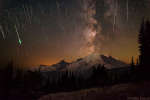 Meteors and Milky Way over Mount Ranier
24.08.2015
Despite appearances, the sky is not falling. Two weeks ago, however, tiny bits of comet dust were. Featured here is the Perseids meteor shower as captured over Mt. Rainier, Washington, USA. The image was created from a two-hour time lapse video, snaring over 20 meteors, including one that brightened dramatically on the image left.
 NGC 6888: The Crescent Nebula
27.11.2025
NGC 6888, also known as the Crescent Nebula, is a about 25 light-years across, a cosmic bubble blown by winds from its central, massive star. This deep telescopic image includes narrowband image data, to isolate light from hydrogen and oxygen atoms.
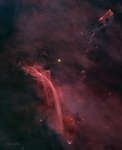 APOD: 2025 December 31 Б HH 222: The Waterfall Nebula
30.12.2025
What created the Waterfall Nebula? The origin is still being researched. The structure, officially designated Herbig-Haro 222, appears in the region of NGC 1999 in the Great Orion Molecular Cloud complex. The elongated gaseous stream stretches about ten light years but appears similar to a long waterfall on Earth.
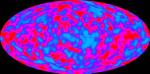 COBE Hotspots: The Oldest Structures Known
6.02.1998
Above is a microwave image of the entire sky. The plane of our galaxy runs horizontally through the center. This historic all-sky map is based on the first two years of data from NASA's COsmic Background Explorer (COBE) satellite.
|
January February March April May June July August September |
|||||||||||||||||||||||||||||||||||||||||||||||||