
|
You entered: dust
 APOD: 2024 December 31 Б The Twisted Disk of NGC 4753
31.12.2024
What do you think this is? HereБs a clue: it's bigger than a bread box. Much bigger. The answer is that pictured NGC 4753 is a twisted disk galaxy, where unusual dark dust filaments provide clues about its history.
 APOD: 2025 January 20 Б Comet ATLAS Rounds the Sun
20.01.2025
Why does Comet ATLAS have such colorful tails? Last week Comet C/2024 G3 (ATLAS) passed its closest to the Sun -- well inside the orbit of Mercury -- and brightened dramatically. Unfortunately, the comet was then so angularly near the Sun that it was very hard for humans to see. But NASA's SOHO spacecraft saw it.
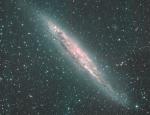 Nearby Spiral Galaxy NGC 4945
21.07.2002
For such a close galaxy, NGC 4945 is easy to miss. NGC 4945 is a spiral galaxy in the Centaurus Group of galaxies, located only six times farther away than the prominent Andromeda Galaxy. The thin disk galaxy is oriented nearly edge-on, however, and shrouded in dark dust.
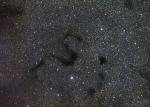 Snake in the Dark
20.06.2003
Dark nebulae snake across a gorgeous expanse of stars in this wide-field view toward the pronounceable constellation Ophiucus and the center of our Milky Way Galaxy. In fact, the central S-shape seen here is well known as the Snake Nebula.
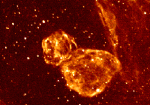 Colliding Supernova Remnants
2.10.1997
When a massive star exhausts its nuclear fuel it explodes. This stellar detonation, a supernova, propels vast amounts of starstuff outwards, initially at millions of miles per hour. For another 100,000 years...
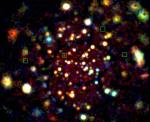 X-Ray Pleiades
5.04.1998
The Pleiades star cluster is one of the jewels of the northern sky. To the unaided eye it appears as a lovely and tantalizing grouping of stars in the constellation of Taurus, while telescopic views reveal cluster stars surrounded by delicate blue wisps of dust-reflected starlight.
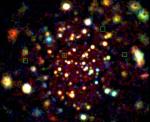 X-Ray Pleiades
28.08.1999
The Pleiades star cluster is one of the jewels of the northern sky. To the unaided eye it appears as an alluring group of stars in the constellation Taurus, while telescopic views reveal cluster stars surrounded by delicate blue wisps of dust-reflected starlight.
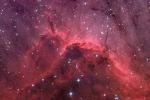 IC 5067: Emission Nebula Close up
27.12.2006
This amazing skyscape lies along a bright ridge of emission in IC 5067, also known as The Pelican Nebula. Appropriately, the Pelican Nebula itself is part of a much larger, complex star-forming region about 2,000 light-years away in the high flying constellation Cygnus, the Swan.
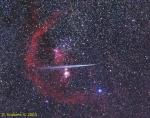 Rocket Fuel
16.11.2007
This gorgeous image of Orion shows off the constellation's young stars and cosmic clouds of hydrogen gas and dust. Made with a film camera tracking the stars on November 11, the exposure lasted some 40 minutes.
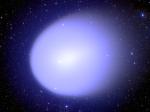 Expansive Comet Holmes
21.11.2007
The spherical coma of Comet Holmes has swollen to a diameter of over 1.4 million kilometers, making the tenuous, dusty cloud even bigger than the Sun. Scattering sunlight, all that dust and gas came...
|
January February March April May |
|||||||||||||||||||||||||||||||||||||||||||||||||