
|
You entered: magnetic field
 APOD: 2024 November 25 Б The Horsehead Nebula
24.11.2024
One of the most identifiable nebulas in the sky, the Horsehead Nebula in Orion, is part of a large, dark, molecular cloud. Also known as Barnard 33, the unusual shape was first discovered on a photographic plate in the late 1800s.
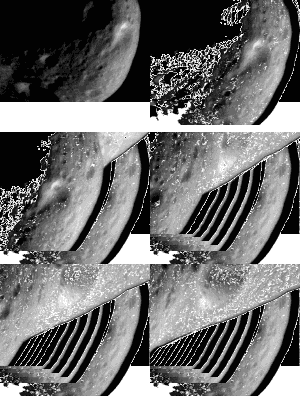 Flying Over Asteroid Eros West End
17.04.2000
The robot spacecraft NEAR Shoemaker continues to orbit asteroid Eros. This condensed 40-minute long time-lapse sequence taken last month shows what it looks like to pass within 200 kilometers of Eros' west end. The north pole of the rotating mountain is toward the bottom of the picture.
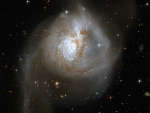 Galaxies Collide in NGC 3256
6.05.2008
Galaxies don't normally look like this. NGC 3256 actually shows a current picture of two galaxies that are slowly colliding. Quite possibly, in hundreds of millions of years, only one galaxy will remain.
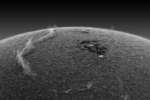 A Filament Across the Sun
20.08.2012
Is that a cloud hovering over the Sun? Yes, but it is quite different than a cloud hovering over the Earth. The long light feature on the left of the above color-inverted image is actually a solar filament and is composed of mostly charged hydrogen gas held aloft by the Sun's looping magnetic field.
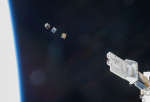 Three CubeSats Released
6.01.2014
Cubes are orbiting the Earth. Measuring ten-centimeters on a side, CubeSats -- each roughly the size of a large coffee mug -- are designed to be inexpensive both to build and to launch. Pictured above, three CubeSats were released from the International Space Station (ISS) last November by the arm of the Japanese Kibo Laboratory module.
 A Split Ion Tail for Comet Lovejoy E4
24.04.2017
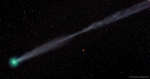
What's happened to Comet Lovejoy? In the pictured image, a processed composite, the comet was captured early this month after brightening unexpectedly and sporting a long and intricate ion tail. Remarkably, the typically...
 The Tails of Comet NEOWISE
10.07.2020
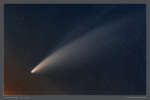
Comet NEOWISE (C/2020 F3) is now sweeping through northern skies. Its developing tails stretch some six degrees across this telescopic field of view, recorded from Brno, Czech Republic before daybreak on July 10. Pushed out by the pressure of sunlight itself, the comet's broad, yellowish dust tail is easiest to see.
 Aurora Crown the Earth
27.05.1996
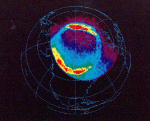
What do aurora look like from space? The POLAR spacecraft answered this by photographing an auroral oval surrounding the north pole of the Earth, causing displays on both the night and day side. The auroral sub-storm, pictured in false-color above, developed within 15 minutes and may have lasted as long as on hour.
 Black Sun and Inverted Starfield
18.02.2017
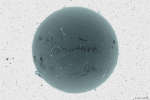
Does this strange dark ball look somehow familiar? If so, that might be because it is our Sun. In the featured image from 2012, a detailed solar view was captured originally in a very specific color of red light, then rendered in black and white, and then color inverted.
 Spot The Planet
9.12.1999
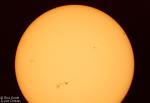
OK, it's a picture of the Sun (duh!), but can you spot the planet? Of course, most of the spots you've spotted are sunspots, as large or larger than planet Earth itself.
|
January February March April May June July August September October |
|||||||||||||||||||||||||||||||||||||||||||||||||