
|
You entered: hot star
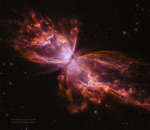 NGC 6302: The Butterfly Nebula
2.03.2019
The bright clusters and nebulae of planet Earth's night sky are often named for flowers or insects. Though its wingspan covers over 3 light-years, NGC 6302 is no exception. With an estimated surface...
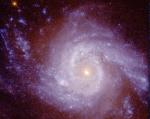 Spiral Galaxy NGC 3310 in Ultraviolet
17.01.2001
Why is NGC 3310 bursting with young stars? The brightest of these new stars are so hot that they light up this spiral galaxy not only in blue light, but in light so blue humans can't see it: ultraviolet. The Hubble Space Telescope took the above photograph in different bands of ultraviolet light.
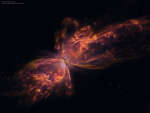 The Butterfly Nebula from Hubble
8.02.2017
The bright clusters and nebulae of planet Earth's night sky are often named for flowers or insects. Though its wingspan covers over 3 light-years, NGC 6302 is no exception. With an estimated surface...
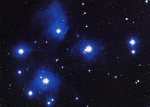 Pleiades Star Cluster
20.06.1995
The Pleiades star cluster, M45, is one of the brightest star clusters visible in the northern hemisphere. It consists of many bright, hot stars that were all formed at the same time within a large cloud of interstellar dust and gas.
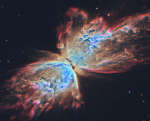 The Butterfly Nebula from Hubble
1.10.2014
The bright clusters and nebulae of planet Earth's night sky are often named for flowers or insects. Though its wingspan covers over 3 light-years, NGC 6302 is no exception. With an estimated surface...
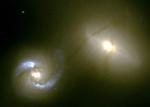 NGC 1410/1409: Intergalactic Pipeline
12.01.2001
These two galaxies are interacting in a surprising way, connected by a "pipeline" of obscuring material that runs between them over 20,000 light-years of intergalactic space. Silhouetted by starlight, the dark, dusty ribbon appears to stretch from NGC 1410 (the galaxy at the left) and wrap itself around NGC 1409 (at right).
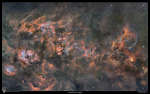 Cygnus Mosaic 2010 2020
11.02.2021
In brush strokes of interstellar dust and glowing gas, this beautiful skyscape is painted across the plane of our Milky Way Galaxy near the northern end of the Great Rift and the constellation Cygnus the Swan.
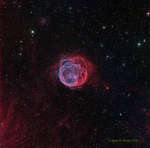 Henize 70: A Superbubble in the LMC
4.02.2019
Massive stars profoundly affect their galactic environments. Churning and mixing interstellar clouds of gas and dust, stars -- most notably those upwards of tens of times the mass of our Sun -- leave their mark on the compositions and locations of future generations of stars.
 NGC 3603: From Beginning To End
4.06.1999
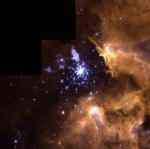
From beginning to end, different stages of a star's life appear in this exciting Hubble Space Telescope picture of the environs of galactic emission nebula NGC 3603. For the beginning, eye-catching "pillars" of glowing hydrogen at the right signal newborn stars emerging from their dense, gaseous, nurseries.
 Cygnus Skyscape
25.07.2019
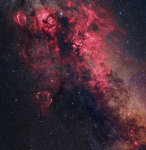
In brush strokes of interstellar dust and glowing hydrogen gas, this beautiful skyscape is painted across the plane of our Milky Way Galaxy near the northern end of the Great Rift and the constellation Cygnus the Swan.
|
January February |
|||||||||||||||||||||||||||||||||||||||||||||||||