
|
You entered: galaxy formation
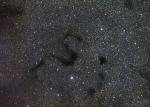 Snake in the Dark
20.06.2003
Dark nebulae snake across a gorgeous expanse of stars in this wide-field view toward the pronounceable constellation Ophiucus and the center of our Milky Way Galaxy. In fact, the central S-shape seen here is well known as the Snake Nebula.
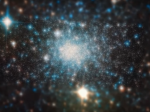 Zooming in on Star Cluster Terzan 5
23.03.2019
Globular clusters once ruled the Milky Way. Back in the old days, back when our Galaxy first formed, perhaps thousands of globular clusters roamed our Galaxy. Today, there are less than 200 left. Over the eons, many globular clusters were destroyed by repeated fateful encounters with each other or the Galactic center.
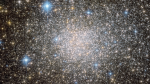 Zooming in on Star Cluster Terzan 5
20.09.2016
Globular clusters once ruled the Milky Way. Back in the old days, back when our Galaxy first formed, perhaps thousands of globular clusters roamed our Galaxy. Today, there are less than 200 left. Over the eons, many globular clusters were destroyed by repeated fateful encounters with each other or the Galactic center.
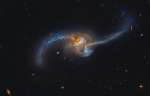 Merging NGC 2623
19.10.2012
NGC 2623 is really two galaxies that are becoming one. Seen to be in the final stages of a titanic galaxy merger, the pair lies some 300 million light-years distant toward the constellation Cancer.
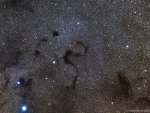 Snake in the Dark
19.02.2009
Dark nebulae snake across a gorgeous expanse of stars in this telescopic view toward the pronounceable constellation Ophiuchus and the center of our Milky Way Galaxy. In fact, the twisting central shape seen here is well known as the Snake Nebula.
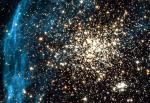 NGC 1850: Not Found in the Milky Way
12.07.2001
A mere 168,000 light-years distant, this large, lovely cluster of stars, NGC 1850, is located near the outskirts of the central bar structure in our neighboring galaxy, the Large Magellanic Cloud. A first...
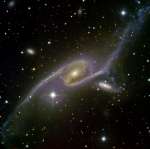 Giant Galaxy NGC 6872
3.04.2011
Over 400,000 light years across NGC 6872 is an enormous spiral galaxy, at least 4 times the size of our own, very large, Milky Way. About 200 million light-years distant, toward the southern...
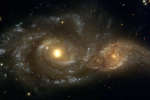 Spiral Galaxies in Collision
20.04.2008
Billions of years from now, only one of these two galaxies will remain. Until then, spiral galaxies NGC 2207 and IC 2163 will slowly pull each other apart, creating tides of matter, sheets of shocked gas, lanes of dark dust, bursts of star formation, and streams of cast-away stars.
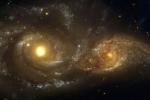 Spiral Galaxies in Collision
8.11.1999
Billions of years from now, only one of these two galaxies will remain. Until then, spiral galaxies NGC 2207 and IC 2163 will slowly pull each other apart, creating tides of matter, sheets of shocked gas, lanes of dark dust, bursts of star formation, and streams of cast-away stars.
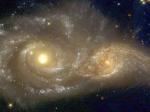 Spiral Galaxies in Collision
20.11.2004
Billions of years from now, only one of these two galaxies will remain. Until then, spiral galaxies NGC 2207 and IC 2163 will slowly pull each other apart, creating tides of matter, sheets of shocked gas, lanes of dark dust, bursts of star formation, and streams of cast-away stars.
|
January February March April May June July August |
||||||||||||||||||||||||||||||||||||||||||||||||||||||||