
|
You entered: dust cloud
 IC 348 and Barnard 3
14.11.2024
A great nebulous region near bright star omicron Persei offers this study in cosmic contrasts. Captured in the telescopic frame the colorful complex of dust, gas, and stars spans about 3 degrees on the sky along the edge of the Perseus molecular cloud some 1000 light-years away.
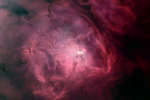 Gas and Dust of the Lagoon Nebula
15.07.2008
This beautiful cosmic cloud is a popular stop on telescopic tours of the constellation Sagittarius. Eighteenth century cosmic tourist Charles Messier cataloged the bright nebula as M8, while modern day astronomers recognize the Lagoon...
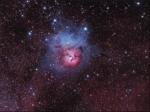 A Beautiful Trifid
26.05.2005
The beautiful Trifid Nebula (aka M20), a photogenic study in cosmic contrasts, lies about 5,000 light-years away toward the nebula rich constellation Sagittarius. A star forming region in the plane of our galaxy...
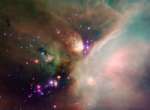 Young Stars in the Rho Ophiuchi Cloud
13.11.2009
Cosmic dust clouds and embedded newborn stars glow at infrared wavelengths in this tantalizing false-color view from the Spitzer Space Telescope. Pictured is of one of the closest star forming regions, part of the Rho Ophiuchi cloud complex some 400 light-years distant near the southern edge of the pronounceable constellation Ophiuchus.
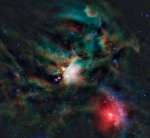 Young Stars in the Rho Ophiuchi Cloud
14.04.2011
Dust clouds and embedded newborn stars glow at infrared wavelengths in this tantalizing false-color composition from WISE, the Wide-field Infrared Survey Explorer. The cosmic canvas features one of the closest star forming regions, part of the Rho Ophiuchi cloud complex some 400 light-years distant near the southern edge of the pronounceable constellation Ophiuchus.
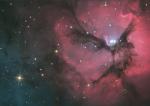 A Beautiful Trifid
1.09.2003
The beautiful Trifid Nebula (aka M20), a photogenic study in cosmic contrasts, lies about 5,000 light-years away toward the nebula rich constellation Sagittarius. A star forming region in the plane of our galaxy...
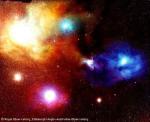 Antares and Rho Ophiuchi
9.05.2004
Why is the sky near Antares and Rho Ophiuchi so colorful? The colors result from a mixture of objects and processes. Fine dust illuminated from the front by starlight produces blue reflection nebulae. Gaseous clouds whose atoms are excited by ultraviolet starlight produce reddish emission nebulae. Backlit dust clouds block starlight and so appear dark.
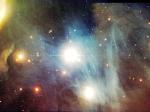 A Chamaeleon Sky
9.06.2002
A photogenic group of nebulae can be found toward Chamaeleon, a constellation visible predominantly in skies south of the Earth's equator. Celestial objects visible there include the blue reflection nebulas highlighted by thin dust surrounding the bright stars in the above image center.
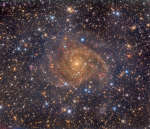 Hidden Galaxy IC 342
29.01.2016
Similar in size to large, bright spiral galaxies in our neighborhood, IC 342 is a mere 10 million light-years distant in the long-necked, northern constellation Camelopardalis. A sprawling island universe, IC 342 would otherwise...
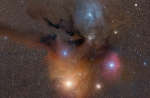 Colorful Clouds Near Rho Ophiuchi
28.08.2012
Why is the sky near Antares and Rho Ophiuchi so colorful? The colors result from a mixture of objects and processes. Fine dust illuminated from the front by starlight produces blue reflection nebulae. Gaseous clouds whose atoms are excited by ultraviolet starlight produce reddish emission nebulae. Backlit dust clouds block starlight and so appear dark.
|
January February March April May June July August September |
|||||||||||||||||||||||||||||||||||||||||||||||||