
|
You entered: dark cloud
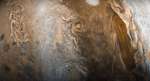 Orbiting Jupiter
7.06.2017
What would it be like to orbit Jupiter? The dramatic featured video depicts just this and was made from images taken by NASA's Juno spacecraft currently orbiting the Jovian giant. Juno recently completed its sixth pass near Jupiter during its looping elliptical six-week orbit.
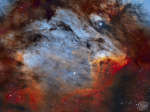 The Pelican Nebula in Gas, Dust, and Stars
25.09.2019
The Pelican Nebula is slowly being transformed. IC 5070, the official designation, is divided from the larger North America Nebula by a molecular cloud filled with dark dust. The Pelican, however, receives much study because it is a particularly active mix of star formation and evolving gas clouds.
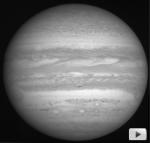 Watch Jupiter Rotate
12.03.2007
What would it be like to coast by Jupiter and watch it rotate? This was just the experience of the New Horizons spacecraft as it approached and flew by Jupiter earlier this year. Clicking on the image will bring up a movie of what the robotic spacecraft saw.
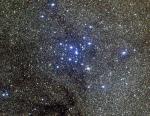 The M7 Open Star Cluster in Scorpius
22.02.2004
M7 is one of the most prominent open clusters of stars on the sky. The cluster, dominated by bright blue stars, can be seen with the naked eye in a dark sky in the tail of the constellation of Scorpius.
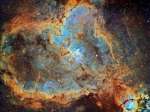 IC 1805: The Heart Nebula
4.03.2013
Sprawling across almost 200 light-years, emission nebula IC 1805 is a mix of glowing interstellar gas and dark dust clouds. Derived from its Valentine's-Day-approved shape, its nickname is the Heart Nebula. About 7,500 light-years away in the Perseus spiral arm of our galaxy, stars were born in IC 1805.
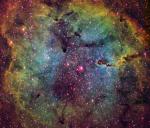 Emission Nebula IC 1396
5.08.2004
Sprawling across hundreds of light-years, emission nebula IC 1396 mixes glowing cosmic gas and dark dust clouds. Stars are forming in this area, only about 3,000 light-years from Earth. This particularly colorful view of the region is a composite of digital images recorded through narrow band filters.
 Stars and Gas of the Running Chicken Nebula
31.05.2016
To some, it looks like a giant chicken running across the sky. To others, it looks like a gaseous nebula where star formation takes place. Cataloged as IC 2944, the Running Chicken Nebula spans about 100 light years and lies about 6,000 light years away toward the constellation of the Centaur (Centaurus).
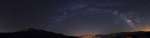 Alborz Mountain Milky Way
3.05.2008
Snow-capped stratovolcano Mt. Damavand climbs to 5,670 meters (18,598 feet) near the left edge in this panoramic view of the world at night. Pan to the right and your gaze will sweep across the arch of our Milky Way Galaxy above the Alborz Mountain Range bordering the Caspian Sea.
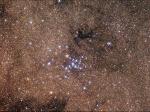 The M7 Open Star Cluster in Scorpius
6.04.2005
M7 is one of the most prominent open clusters of stars on the sky. The cluster, dominated by bright blue stars, can be seen with the naked eye in a dark sky in the tail of the constellation of Scorpius.
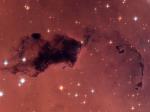 A Dust Cloud in NGC 281
20.04.2006
Stars themselves can create huge and intricate dust sculptures from the dense and dark molecular clouds from which they are born. The tools the stars use to carve their detailed works are high energy light and fast stellar winds.
|
January February March April May June July August September |
|||||||||||||||||||||||||||||||||||||||||||||||||