
|
You entered: atmosphere
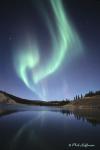 Dueling Auroras
3.12.2001
Will it be curtains for one of these auroras? A quick inspection indicates that it is curtains for both, as the designation "curtains" well categorizes the type of aurora pattern pictured. Another (informal) type is the corona. The above auroras resulted from outbursts of ionic particles from the Sun during the last week of September.
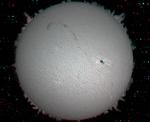 A Stereo Sun
26.11.2005
A stereo view of the closest star, this creatively composited image was constructed from an extensive archive of pictures taken between March 2004 and April 2005. When viewed with red/blue glasses, the Sun's disk and surface features, including sunspots, filaments, and prominences, stand out in an exaggerated stereo perspective.
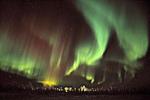 Aurora Over Circle, Alaska
1.01.1997
Aurora can make spectacular sights. This particular aurora was photographed hovering over the town of Circle, Alaska. Although Aurora might first appear to be moonlit clouds, they only add light to the sky, and hence can not block background stars from view.
 The Comet and the Galaxy
25.11.1997
The Moon almost ruined this photograph. During late March and early April, Comet Hale-Bopp passed nearly in front of the Andromeda Galaxy. Here the Great Comet of 1997 and the Great Galaxy in Andromeda were photographed together on March 24th. The problem was the brightness of the Moon.
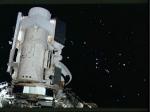 Astro 1 In Orbit
20.02.1999
In December of 1990, the Space Shuttle Columbia carried an array of astronomical telescopes high above the Earth's obscuring atmosphere to observe the Universe at ultraviolet and x-ray wavelengths. The telescopes, known...
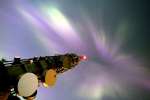 Auroral Corona Over Norway
1.02.2009
Higher than highest communications tower, higher than highest mountain, higher than highest airplane, lies the realm of the aurora. Auroras rarely reach below 60 kilometers, and can range up to 1000 kilometers. Aurora light results from energetic electrons and protons striking molecules in the Earth's atmosphere.
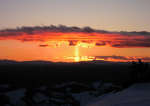 Pillar at Sunset
6.03.2010
Reddened light from the setting Sun illuminates the cloud banks hugging this snowy, rugged terrain. Inspiring a moment of quiet contemplation, the sunset scene included a remarkable pillar of light that seemed to connect the clouds in the sky with the mountains below.
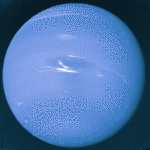 Neptune: Big Blue Giant
21.02.1998
This picture was taken by the Voyager 2 spacecraft in 1989 - the only spacecraft ever to visit Neptune. Neptune will be the farthest planet from the Sun until 1999, when the elliptical orbit of Pluto will cause it to once again resume this status.
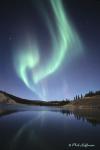 Dueling Auroras
7.08.2005
Will it be curtains for one of these auroras? A quick inspection indicates that it is curtains for both, as the designation "curtains" well categorizes the type of aurora pattern pictured. Another (informal) type is the corona.
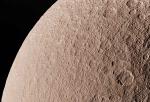 Rhea: Saturns Second Largest Moon
5.12.1999
Rhea is the second largest moon of Saturn, behind Titan, and the largest without an atmosphere. It is composed mostly of water ice, but has a small rocky core. Rhea's rotation and orbit are locked together (just like Earth's Moon) so that one side always faces Saturn.
|
January February March April May June July August September |
|||||||||||||||||||||||||||||||||||||||||||||||||