
|
You entered: unidentified sources
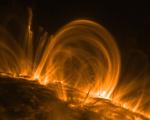 Heating Coronal Loops
28.09.2000
Extending above the photosphere or visible surface of the Sun, the faint, tenuous solar corona can't be easily seen from Earth, but it is measured to be hundreds of times hotter than the photosphere itself. What makes the solar corona so hot?
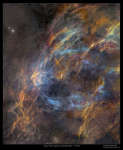 Cygnus Shell Supernova Remnant W63
1.11.2018
The ghost of a long-dead star, the W63 supernova remnant shines like a faint cosmic smoke-ring along the plane of the Milky Way galaxy toward the northern constellation Cygnus the swan. Its wraithlike appearance is traced against the region's rich complex of interstellar clouds and dust by an eerie blue glow.
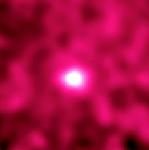 The Gamma Ray Moon
9.02.1997
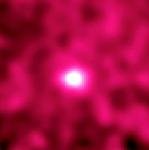
What if you could see gamma rays (photons with more than 40 million times the energy of visible light)? If you could, the Moon would appear brighter than the Sun! This startling notion...
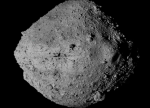 Places for OSIRIS REx to Touch Asteroid Bennu
22.12.2019
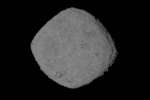
Where is the best place to collect a surface sample from asteroid Bennu? Launched in 2016, NASA sent the robotic Origins, Spectral Interpretation, Resource Identification, Security, Regolith Explorer (OSIRIS-REx) to investigate the 500-meter-across asteroid 101955 Bennu.
 Gamma Ray Moon
17.04.1999
What if you could see gamma rays (photons with more than 40 million times the energy of visible light)? If you could, the Moon would appear brighter than the Sun! This startling notion...
 Rotating Asteroid Bennu from OSIRIS REx
12.11.2018
Could this close-by asteroid ever hit the Earth? Eventually yes -- but probably not for a very long time, even though the asteroid is expected to pass inside the orbit of the Moon next century.
 Rungs of the Red Rectangle
13.05.2004
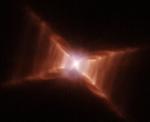
A distinctive X-shape and ladder-like rungs appear in this Hubble Space Telescope image of the intriguing Red Rectangle Nebula. The dusty cosmic cloud was originally identified as a strong source of infrared radiation and is now believed to contain icy dust grains and hydrocarbon molecules formed in the cool outflow from an aging central star.
 Fomalhaut's Dusty Debris Disk
10.05.2023
Fomalhaut is a bright star, a 25 light-year voyage from planet Earth in the direction of the constellation Piscis Austrinus. Astronomers first noticed Fomalhaut's excess infrared emission in the 1980s. Space and ground-based...
 Enceladus Ice Geysers
13.10.2007
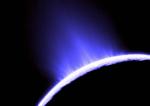
Ice geysers erupt on Enceladus, bright and shiny inner moon of Saturn. Shown in this false-color image, a backlit view of the moon's southern limb, the majestic, icy plumes were discovered by instruments on the Cassini Spacecraft during close encounters with Enceladus in November of 2005.
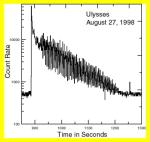 SGR 1900+14 : Magnetar
3.09.1998
On August 27th an intense flash of X-rays and gamma-rays swept through our Solar System. Five spacecraft of the Third InterPlanetary gamma-ray burst Network, Ulysses, WIND, RXTE, NEAR, and BeppoSAX, recorded the high energy...
|
January February March April May June July August |
||||||||||||||||||||||||||||||||||||||||||||||||||||||||