
|
You entered: solar cycle
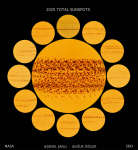 APOD: 2026 February 11 Б A Year of Sunspots
11.02.2026
How many sunspots can you see? The central image shows the many sunspots that occurred in 2025, month by month around the circle, and all together in the grand central image. Each sunspot is magnetically cooled and so appears dark -- and can last from days to months.
 Auroral Corona
1.01.2026
Cycle 25 solar maximum made 2025 a great year for aurora borealis (or aurora australis) on planet Earth. And the high level of solar activity should extend into 2026. So, while you're celebrating the arrival of the new year, check out this spectacular auroral display that erupted in starry night skies over Kirkjufell, Iceland.
 A Year on the Sun
26.04.2013
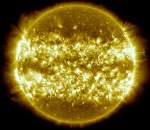
Our solar system's miasma of incandescent plasma, the Sun may look a little scary here. The picture is a composite of 25 images recorded in extreme ultraviolet light by the orbiting Solar Dynamics Observatory between April 16, 2012 and April 15, 2013.
 APOD: 2023 July 11 Б Sunspots on an Active Sun
11.07.2023
Why is our Sun so active now? No one is sure. An increase in surface activity was expected because our Sun is approaching solar maximum in 2025. However, last month our Sun sprouted more sunspots than in any month during the entire previous 11-year solar cycle -- and even dating back to 2002.
 A Twisted Solar Eruptive Prominence
1.06.2008
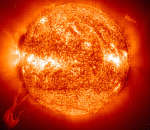
Ten Earths could easily fit in the "claw" of this seemingly solar monster. The monster, though, visible on the lower left, is a huge eruptive prominence seen moving out from our Sun. The above dramatic image taken early in the year 2000 by the Sun-orbiting SOHO satellite.
 A Twisted Solar Eruptive Prominence
3.04.2000
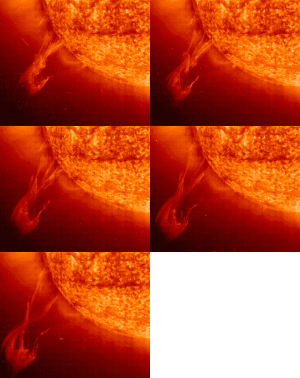
A huge eruptive prominence is seen moving out from our Sun in this condensed half-hour time-lapse sequence. Ten Earths could easily fit in the "claw" of this seemingly solar monster. This large prominence, though, is significant not only for its size, but its shape.
 A Twisted Solar Eruptive Prominence
24.01.2015
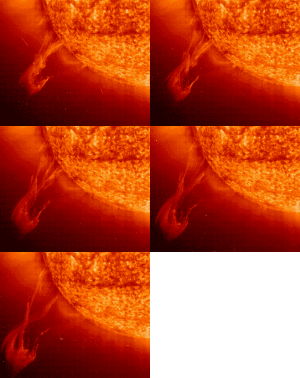
Ten Earths could easily fit in the "claw" of this seemingly solar monster. The monster, actually a huge eruptive prominence, is seen moving out from our Sun in this condensed half-hour time-lapse sequence. This large prominence, though, is significant not only for its size, but its shape.
 A Twisted Solar Eruptive Prominence
23.02.2003
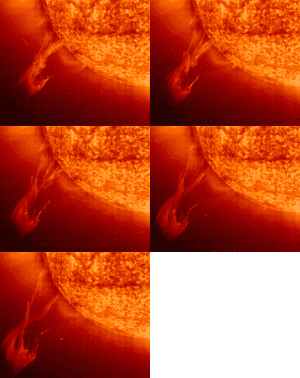
A huge eruptive prominence is seen moving out from our Sun in this condensed half-hour time-lapse sequence. Ten Earths could easily fit in the "claw" of this seemingly solar monster. This large prominence, though, is significant not only for its size, but its shape.
 Spotty Sunrise over Brisbane
11.07.2014
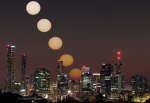
In this composite cityscape, dawn's first colors backdrop the lights along Brisbane's skyline at the southeastern corner of Queensland, Australia, planet Earth. Using a solar filter, additional exposures made every 3.5 minutes follow the winter sunrise on July 8 as planet-sized sunspots cross the visible solar disk.
 Prominences and Filaments on the Active Sun
15.06.2024
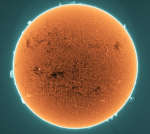
This colorized and sharpened image of the Sun is composed of frames recording emission from hydrogen atoms in the solar chromosphere on May 15. Approaching the maximum of solar cycle 25, a multitude of active regions and twisting, snake-like solar filaments are seen to sprawl across the surface of the active Sun.
|
January February March April May June July August September |
|||||||||||||||||||||||||||||||||||||||||||||||||