
|
You entered: runaway star
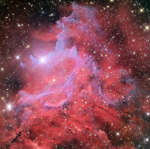 Flaming Star Nebula
1.12.2016
A runaway star lights the Flaming Star Nebula in this cosmic scene. Otherwise known as IC 405, the Flaming Star Nebula's billowing interstellar clouds of gas and dust lie about 1,500 light-years away toward the constellation of Auriga.
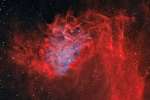 AE Aurigae and the Flaming Star Nebula
11.03.2011
AE Aurigae is the bright star below and left of center in this evocative portrait of IC 405, also known as the Flaming Star Nebula. Embedded in the cosmic cloud, the hot, variable O-type star energizes the glow of hydrogen along convoluted filaments of atomic gas, its blue starlight scattered by interstellar dust.
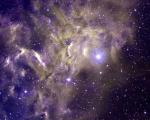 AE Aurigae: The Flaming Star
4.12.2001
Is star AE Aurigae on fire? Although surrounded by what may look like smoke, the object known as the "flaming star" creates energy primarily by nuclear fusion, like other stars. Fire, typically defined...
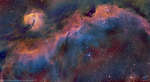 The Seagull Nebula
19.01.2023
A broad expanse of glowing gas and dust presents a bird-like visage to astronomers from planet Earth, suggesting its popular moniker - The Seagull Nebula. Using narrowband image data, this 3-panel mosaic of the cosmic...
 APOD: 2025 August 29 Б A Dark Veil in Ophiuchus
29.08.2025
The diffuse hydrogen-alpha glow of emission region Sh2-27 fills this cosmic scene. The field of view spans nearly 3 degrees across the nebula-rich constellation Ophiuchus toward the central Milky Way. A Dark Veil...
 APOD: 2025 June 26 Б The Seagull Nebula
26.06.2025
An interstellar expanse of glowing gas and obscuring dust presents a bird-like visage to astronomers from planet Earth, suggesting its popular moniker, the Seagull Nebula. This broadband portrait of the cosmic bird covers...
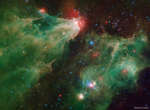 The Cave Nebula in Infrared from Spitzer
11.06.2019
What's happening in and around the Cave Nebula? To help find out, NASA's orbiting Spitzer Space Telescope looked into this optically-dark star-forming region in four colors of infrared light. The Cave Nebula...
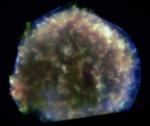 X Rays From Tycho s Supernova Remnant
12.09.2002
In 1572, Danish astronomer Tycho Brahe recorded the sudden appearance of a bright new star in the constellation Cassiopeia. The new star faded from view over a period of months and is believed to have been a supernova, one of the last stellar explosions seen in our Milky Way galaxy.
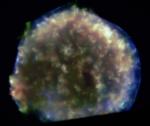 X Rays From Tycho s Supernova Remnant
22.05.2004
In 1572, Danish astronomer Tycho Brahe recorded the sudden appearance of a bright new star in the constellation Cassiopeia. The new star faded from view over a period of months and is believed to have been a supernova, one of the last stellar explosions seen in our Milky Way galaxy.
 At the Core of M15
20.11.1995
Densely packed stars in the core of the globular cluster M15 are shown in this Hubble Space Telescope (HST) image taken in April of 1994. The stars revealed are contained in an area 1.6 light years across and their colors roughly indicate their temperatures - hot stars appear blue, cooler stars look reddish-orange.
|
January February March April May June July August September |
|||||||||||||||||||||||||||||||||||||||||||||||||