
|
You entered: main sequence
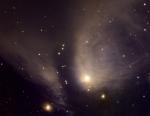 Portrait of RY Tauri
23.09.2005
A star emerges from its natal cloud of gas and dust in this tantalizing portrait of RY Tauri, a small stellar nursery at the edge of the Taurus molecular cloud, a mere 450 light-years away.
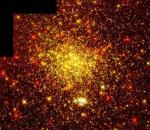 NGC1850: Star Cluster in the LMC
29.07.2000
NGC1850 is a large cluster of stars located a mere 166,000 light-years from Earth in our neighboring galaxy the Large Magellanic Cloud (LMC). The colors in this beautiful Hubble Space Telescope composite image of the cluster reveal different populations of stars.
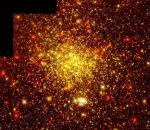 NGC1850: Star Cluster in the LMC
20.06.1997
NGC1850 is a large cluster of stars located a mere 166,000 light-years from Earth in our neighboring galaxy the Large Magellanic Cloud (LMC). The colors in this beautiful Hubble Space Telescope composite image of the cluster reveal different populations of stars.
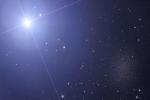 Bright Star Regulus near the Leo 1 Dwarf Galaxy
19.06.2006
The star on the upper left is so bright it is sometimes hard to notice the galaxy on the lower right. Both the star, Regulus, and the galaxy, Leo I, can be found within one degree of each other toward the constellation of Leo.
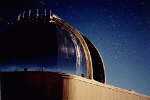 IRTF: Scanning the Infrared Skies
4.09.1996
Above, NASA's Infrared Telescope Facility (IRTF) poses in front of a starry background. Located on top of Hawaii's towering volcano Mauna Kea, the IRTF is the premier telescope for observing in near infrared light. This 3-meter telescope was established in 1979 and spends about half its time observing Solar System objects.
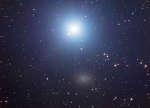 Bright Star Regulus near the Leo I Dwarf Galaxy
10.01.2012
The star near the top is so bright that it is sometimes hard to notice the galaxy toward the bottom. Pictured above, both the star, Regulus, and the galaxy, Leo I, can be found within one degree of each other toward the constellation of the Lion (Leo).
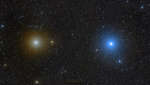 Gemini Stars Pollux and Castor
16.05.2017
Who are the twins of Gemini? It terms of astronomical objects, the famous constellation is dominated by two bright stars: Pollux (left) and Castor (right). Pictured, the two stars stand out because they are so bright, so close together both in angle and brightness, but so different in color.
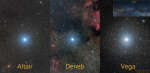 Stars of a Summer Triangle
27.06.2015
Rising at the start of a northern summer's night, these three bright stars form the familiar asterism known as the Summer Triangle. Altair, Deneb, and Vega are the alpha stars of their respective constellations, Aquila, Cygnus, and Lyra, nestled near the Milky Way.
 GL 105C: The Coolest Star?
20.09.1995
Is the dim star to the upper right of this false-color picture the coolest possible normal star? From this recent picture by the Hubble Space Telescope, astronomers have estimated its mass is just high enough for it to fuse hydrogen into helium in its core.
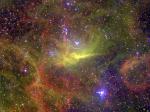 Nebulas Surrounding Wolf Rayet Binary
BAT99 49
Nebulas Surrounding Wolf Rayet Binary
BAT99 49
21.04.2004
How could two young stars power these colorful interstellar gas clouds? Although hidden by thick dust, the stars spew forceful ions and energetic radiation that cause the clouds to fragment and light up.
|
January February March April May June July August September |
|||||||||||||||||||||||||||||||||||||||||||||||||