
|
You entered: magnetic cycle
 Large Sunspot Group AR 9393
11.04.2001
The largest sunspot group of the past ten years crossed the surface of the Sun late last month and early this month. The group was designated Active Region 9393 as it was the 9393rd region identified since counting officially began in 1973.
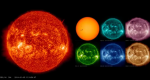 The Sun Rotating
12.03.2014
Does the Sun change as it rotates? Yes, and the changes can vary from subtle to dramatic. In the above time-lapse sequences, our Sun -- as imaged by NASA's Solar Dynamics Observatory -- is shown rotating though the entire month of January.
 APOD: 2020 August 19 Б The Sun Rotating
19.08.2020
Does the Sun change as it rotates? Yes, and the changes can vary from subtle to dramatic. In the featured time-lapse sequences, our Sun -- as imaged by NASA's Solar Dynamics Observatory -- is shown rotating though an entire month in 2014.
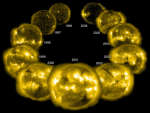 A Complete Solar Cycle from SOHO
3.12.2007
Every eleven years, our Sun goes through a solar cycle. A complete solar cycle has now been imaged by the sun-orbiting SOHO spacecraft, celebrating the 12th anniversary of its launch yesterday. A solar cycle...
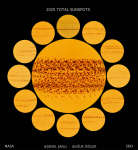 APOD: 2026 February 11 Б A Year of Sunspots
11.02.2026
How many sunspots can you see? The central image shows the many sunspots that occurred in 2025, month by month around the circle, and all together in the grand central image. Each sunspot is magnetically cooled and so appears dark -- and can last from days to months.
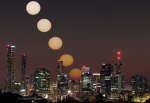 Spotty Sunrise over Brisbane
11.07.2014
In this composite cityscape, dawn's first colors backdrop the lights along Brisbane's skyline at the southeastern corner of Queensland, Australia, planet Earth. Using a solar filter, additional exposures made every 3.5 minutes follow the winter sunrise on July 8 as planet-sized sunspots cross the visible solar disk.
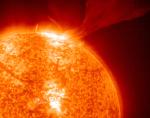 A Solar Prominence Erupts
24.09.2001
Our Sun is still very active. Last year, our Sun went though Solar Maximum, the time in its 11-year cycle where the most sunspots and explosive activities occur. Sunspots, the Solar Cycle, and solar prominences are all caused by the Sun's changing magnetic field.
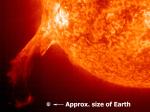 An Erupting Solar Prominence from SOHO
7.08.2006
Our Sun is still very active. In the year 2000, our Sun went though Solar Maximum, the time in its 11-year cycle where the most sunspots and explosive activities occur. Sunspots, the Solar Cycle, and solar prominences are all caused by the Sun's changing magnetic field.
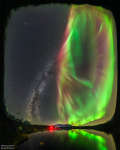 Milky Way Auroral Flower
18.10.2022
Could the stem of our Milky Way bloom into an auroral flower? No, not really, even though it may appear that way in todayБs featured all-sky image. On the left, the central plane of our home galaxy extends from the horizon past the middle of the sky.
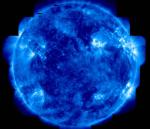 Autumn and the Active Sun
23.09.1998
As the Sun heads South, crossing the celestial equator today at 1:37 a.m. Eastern Time, Autumn begins for Earth's Northern Hemisphere. This Autumnal Equinox finds an increasingly active Sun steadily approaching a solar cycle maximum expected around the year 2003.
|
January February March April May June July August September |
|||||||||||||||||||||||||||||||||||||||||||||||||