
|
You entered: ionization front
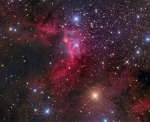 Sh2 155: The Cave Nebula
19.10.2013
This colorful skyscape features the dusty, reddish glow of Sharpless catalog emission region Sh2-155, the Cave Nebula. About 2,400 light-years away, the scene lies along the plane of our Milky Way Galaxy toward the royal northern constellation of Cepheus.
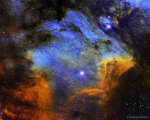 The Pelican Nebula in Gas Dust and Stars
17.11.2015
The Pelican Nebula is slowly being transformed. IC 5070, the official designation, is divided from the larger North America Nebula by a molecular cloud filled with dark dust. The Pelican, however, receives much study because it is a particularly active mix of star formation and evolving gas clouds.
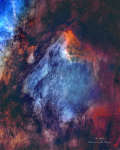 APOD: 2026 September 7 Б The Pelican Nebula in Gas, Dust, and Stars
7.09.2026
The Pelican Nebula is slowly being transformed. IC 5070 (an official designation) is divided from the larger North America Nebula by a molecular cloud filled with dark dust. The deep featured picture from Utah, USA incorporates 25 hours of exposure and brings out great details of this filamentary dust.
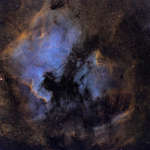 North America and the Pelican
18.12.2010
Here lie familiar shapes in unfamiliar locations. On the left is an emission nebula cataloged as NGC 7000, famous partly because it resembles our fair planet's continent of North America. The emission region to the right of the North America Nebula is IC 5070, also known for its suggestive outlines as the Pelican Nebula.
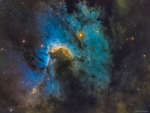 The Cave Nebula in Hydrogen, Oxygen, and Sulfur
14.11.2018
What's inside this cosmic cave? A stellar nursery 10 light-years deep. The featured skyscape is dominated by dusty Sh2-155, the Cave Nebula. In the telescopic image, data taken through a narrowband filters tracks the nebular glow of hydrogen, oxygen, and sulfur, colors that together form the Hubble Palette.
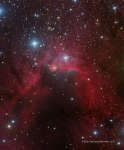 SH2-155: The Cave Nebula
23.03.2017
This skyscape features dusty Sharpless catalog emission region Sh2-155, the Cave Nebula. In the telescopic image, data taken through a narrowband filter tracks the reddish glow of ionized hydrogen atoms. About 2,400 light-years away, the scene lies along the plane of our Milky Way Galaxy toward the royal northern constellation of Cepheus.
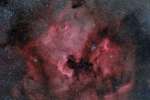 North America and the Pelican
3.09.2013
Here lie familiar shapes in unfamiliar locations. On the left is an emission nebula cataloged as NGC 7000, famous partly because it resembles our fair planet's continent of North America. The emission region to the right of the North America Nebula is IC 5070, also known for its suggestive outlines as the Pelican Nebula.
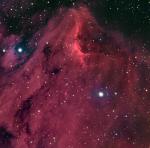 The Pelican in the Swan
29.08.2002
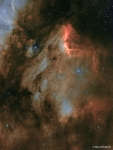
The Pelican Nebula, also known as IC 5070, lies about 2,000 light-years away in the high and far-off constellation of Cygnus, the Swan. This picture spans a portion of the magnificent nebula about 30 light-years wide.
 IC 5070: A Dusty Pelican in the Swan
19.11.2016
The recognizable profile of the Pelican Nebula soars nearly 2,000 light-years away in the high flying constellation Cygnus, the Swan. Also known as IC 5070, this interstellar cloud of gas and dust...
 SH2 155: The Cave Nebula
5.11.2014
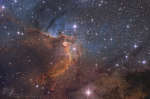
This colorful skyscape features the dusty Sharpless catalog emission region Sh2-155, the Cave Nebula. In the composite image, data taken through narrowband filters tracks the glow of ionized sulfur, hydrogen, and oxygen atoms in red, green, and blue hues.
|
January February March April May June July August September October November |
||||||||||||||||||||||||||||||||||||||||||||||||||||||||