
|
You entered: hot star
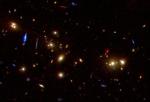 The Lynx Arc
5.11.2003
While chasing the spectrum of a mysterious arc in a cluster of galaxies within the obscure northerly constellation Lynx, astronomers have stumbled upon the most massive and distant star-forming region ever discovered. The notably...
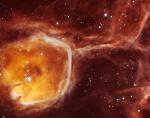 Windblown N44F
19.08.2004
A fast and powerful wind from a hot young star has created this stunning bubble-shaped nebula poised on the end of a bright filament of hydrogen gas. Cataloged as N44F, the cosmic windblown bubble is seen at the left of this Hubble Space Telescope image.
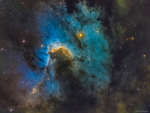 The Cave Nebula in Hydrogen, Oxygen, and Sulfur
14.11.2018
What's inside this cosmic cave? A stellar nursery 10 light-years deep. The featured skyscape is dominated by dusty Sh2-155, the Cave Nebula. In the telescopic image, data taken through a narrowband filters tracks the nebular glow of hydrogen, oxygen, and sulfur, colors that together form the Hubble Palette.
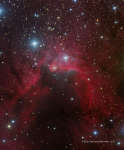 SH2-155: The Cave Nebula
23.03.2017
This skyscape features dusty Sharpless catalog emission region Sh2-155, the Cave Nebula. In the telescopic image, data taken through a narrowband filter tracks the reddish glow of ionized hydrogen atoms. About 2,400 light-years away, the scene lies along the plane of our Milky Way Galaxy toward the royal northern constellation of Cepheus.
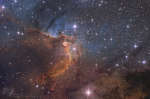 SH2 155: The Cave Nebula
5.11.2014
This colorful skyscape features the dusty Sharpless catalog emission region Sh2-155, the Cave Nebula. In the composite image, data taken through narrowband filters tracks the glow of ionized sulfur, hydrogen, and oxygen atoms in red, green, and blue hues.
 The Medusa Nebula
22.11.2024
Braided and serpentine filaments of glowing gas suggest this nebula's popular name, The Medusa Nebula. Also known as Abell 21, this Medusa is an old planetary nebula some 1,500 light-years away in the constellation Gemini. Like its mythological namesake, the nebula is associated with a dramatic transformation.
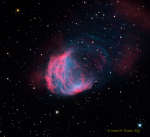 The Medusa Nebula
26.03.2021
Braided and serpentine filaments of glowing gas suggest this nebula's popular name, The Medusa Nebula. Also known as Abell 21, this Medusa is an old planetary nebula some 1,500 light-years away in the constellation Gemini. Like its mythological namesake, the nebula is associated with a dramatic transformation.
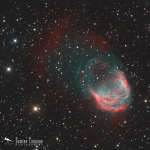 The Medusa Nebula
25.03.2022
Braided and serpentine filaments of glowing gas suggest this nebula's popular name, The Medusa Nebula. Also known as Abell 21, this Medusa is an old planetary nebula some 1,500 light-years away in the constellation Gemini. Like its mythological namesake, the nebula is associated with a dramatic transformation.
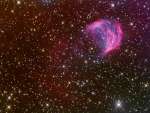 The Medusa Nebula
12.06.2010
Braided, serpentine filaments of glowing gas suggest this nebula's popular name, The Medusa Nebula. Also known as Abell 21, this Medusa is an old planetary nebula some 1,500 light-years away in the constellation Gemini. Like its mythological namesake, the nebula is associated with a dramatic transformation.
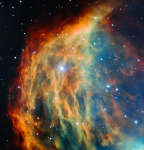 The Medusa Nebula
12.06.2015
Braided, serpentine filaments of glowing gas suggest this nebula's popular name, The Medusa Nebula. Also known as Abell 21, this Medusa is an old planetary nebula some 1,500 light-years away along the southern border of the constellation Gemini. Like its mythological namesake, the nebula is associated with a dramatic transformation.
|
January February |
|||||||||||||||||||||||||||||||||||||||||||||||||