
|
You entered: host galaxy
 A Nearby Supernova in Spiral Galaxy M100
7.03.2006
One of the nearer supernovas of recent years was discovered last month in the bright nearby galaxy M100. The supernova, dubbed SN 2006X, is still near its maximum brightness and visible with a telescope...
 APOD: 2025 July 31 Б Supernova 2025rbs in NGC 7331
31.07.2025
A long time ago in a galaxy 50 million light-years away, a star exploded. Light from that supernova was first detected by telescopes on planet Earth on July 14th though, and the extragalactic transient is now known to astronomers as supernova 2025rbs.
 Why is QSO 1229+204 so Bright?
24.08.1996
What causes the center of this barred spiral galaxy to light up brighter than almost anything in the universe? The quasar there is a good fraction of the way across our observable universe...
 A Gamma Ray Burst Supernova
8.05.1998
Did a gamma-ray burst precede this supernova? This intriguing suggestion came to light yesterday with the discovery of an evolving supernova that is potentially coincident with the position of gamma-ray burst GRB 980425, which occurred just two weeks ago. If true, this would tie together the two most violent phenomena known in the universe.
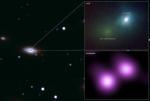 SN 2006GY: Brightest Supernova
10.05.2007
The stellar explosion cataloged as supernova SN 2006gy shines in this wide-field image (left) of its host galaxy, NGC 1260, and expanded view (upper right panel) of the region surrounding the galaxy's core.
 GRB Fireball Persists
17.09.1997
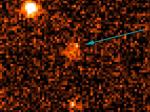
It's still there. The optical counterpart to the instantly famous gamma-ray burst (GRB) that occurred last February 28th has faded - but not completely. The astronomical community had waited patiently for months...
 A Five Quasar Gravitational Lens
24.05.2006
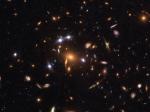
What's happening near the center of this cluster of galaxies? At first glance, it appears that several strangely elongated galaxies and fully five bright quasars exist there. In reality, an entire cluster of galaxies is acting as a gigantic gravitational lens that distorts and multiply-images bright objects that occur far in the distance.
 Globular Star Cluster M3
9.06.2007
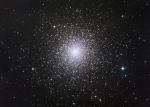
This immense ball of half a million stars older than the Sun lies over 30,000 light-years away. Cataloged as M3 (and NGC 5272), it is one of about 150 globular star clusters that roam the halo of our Milky Way Galaxy.
 A Gamma Ray Burst Supernova Connection
14.04.2003
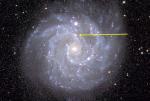
New evidence has emerged that a mysterious type of explosion known as a gamma ray burst is indeed connected to a supernova of the type visible in the above image. Two weeks ago, the orbiting HETE satellite detected gamma-ray burst GRB030329.
 Gamma Ray Burst Afterglow: Supernova Connection
5.04.2002
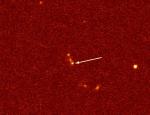
What causes the mysterious gamma-ray bursts? Indicated in this Hubble Space Telescope exposure of an otherwise unremarkable field in the constellation Crater, is the dwindling optical afterglow of a gamma-ray burst first detected by the Beppo-SAX satellite on 2001 December 11.
|
January February March April May June July August September |
|||||||||||||||||||||||||||||||||||||||||||||||||