
|
You entered: dust disk
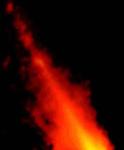 Rings Around Beta Pictoris
8.02.2000
An unusual dust disk surrounds nearby star Beta Pictoris. Discovered in 1983, astronomers are still learning just how unusual this disk is. Recent images and computer simulations indicate that the disk contains several elliptical dust rings larger than our own Solar System.
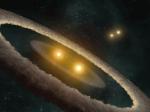 The Four Suns of HD 98800
30.07.2007
How would it look to have four suns in the sky? Planets of the HD 98800 system, if they exist, would experience such a view. HD 98800 is a multiple star system about 150 light years from Earth -- right in our section of the Milky Way Galaxy.
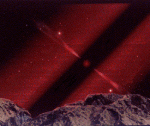 Planet Near a Galaxy Core
5.05.1996
What would the night sky look like if you lived on a planet near the center of a galaxy? Now imagine that this galaxy houses a black hole billions of times more massive than a star. From this spectacular vantage point, the sky might look like the above illustration.
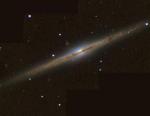 Edge-On Spiral Galaxy NGC 891
28.02.1997
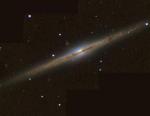
Is our Galaxy this thin? We believe so. The Milky Way, like NGC 891 pictured above, has the width of a typical spiral galaxy. Spirals have most of their bright stars, gas, and obscuring dust in a thin disk.
 Edge On Spiral Galaxy NGC 891
20.12.1998
Is our Galaxy this thin? We believe so. The Milky Way, like NGC 891 pictured above, has the width of a typical spiral galaxy. Spirals have most of their bright stars, gas, and obscuring dust in a thin disk.
 Possible Planets And Infrared Dust
20.01.1999
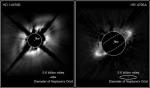
These near-infrared Hubble images of dust surrounding young stars offer the latest tantalizing evidence for planets beyond our Solar System. At left, the dark gap seen in the dust disk is reminiscent of a similar large gap in Saturn's rings believed to be sculpted by orbiting moons.
 Trapezium: Teardrops in My Skies
28.02.1999
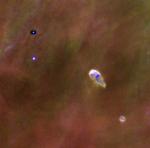
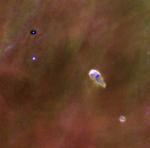
Sometimes the unexpected comes in a familiar shape. In this picture, the seemingly familiar teardrop-shaped object just right of center is actually an unusually situated disk of gas and dust. In fact, the teardrop is about the size of our own Solar System and is racing against time to condense and form planets.
 Trapezium: Teardrops in My Skies
16.01.1997
Sometimes the unexpected comes in a familiar shape. In this recently released picture, the seemingly familiar teardrop-shaped object just right of center is actually an unusually situated disk of gas and dust. In fact, the teardrop is about the size of our own Solar System and is racing against time to condense and form planets.
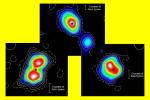 Three Dusty Stars
23.04.1998
These separate radio images reveal three dusty debris disks surrounding three bright, young, nearby stars - evidence for solar systems in formation. From left to right are the stars Fomalhaut, Beta Pictoris, and Vega, their positions indicated by star symbols. The false color maps show the intensity of submillimeter radio emission from the surrounding dust.
 APOD: 2025 February 19 Б HH 30: A Star System with Planets Now Forming
19.02.2025
How do stars and planets form? New clues have been found in the protoplanetary system Herbig-Haro 30 by the James Webb Space Telescope in concert with Hubble and the Earth-bound ALMA. The observations show, among other things, that large dust grains are more concentrated into a central disk where they can form planets.
|
January February March April May June July August September |
|||||||||||||||||||||||||||||||||||||||||||||||||