
|
You entered: comet Halley
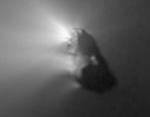 Halley s Nucleus: An Orbiting Iceberg
5.08.2000
What does a comet nucleus look like? Formed from the primordial stuff of the solar system, it is thought to resemble a very dirty iceberg. But for active comets, telescopic images only reveal the surrounding cloud of gas and dust, the comet's coma, and the characteristic cometary tails.
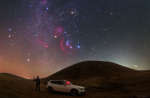 Orionid Meteors from Orion
29.10.2017
Meteors have been shooting out from the constellation of Orion. This was expected, as October is the time of year for the Orionids Meteor Shower. Pictured here, over a dozen meteors were caught in successively added exposures last weekend over Wulan Hada volcano in Inner Mongolia, China.
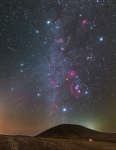 Orionids Meteors over Inner Mongolia
29.10.2018
Meteors have been shooting out from the constellation of Orion. This was expected, as October is the time of year for the Orionids Meteor Shower. Pictured here, over two dozen meteors were caught in successively added exposures last October over Wulan Hada volcano in Inner Mongolia, China.
 Seven Years of Halley Dust
27.10.2022
History's first known periodic comet Halley (1P/Halley) returns to the inner Solar System every 75 years or so. The famous comet made its last appearance to the naked-eye in 1986. But dusty debris...
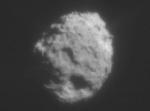 Comet Wild 2s Nucleus from Stardust
2.01.2004
What does a comet nucleus look like? Yesterday the robot spacecraft Stardust answered this question by returning the most detailed images yet of the center of a comet. The icy centers of comets are usually hidden from Earth-bound telescopes by opaque dust and gas that boils off during approach to the Sun.
 Comet 12P/Pons Brooks in Northern Spring
8.03.2024
As spring approaches for northern skygazers Comet 12P/Pons-Brooks is growing brighter. Currently visible with small telescopes and binoculars the Halley-type comet could reach naked eye visibility in the coming weeks. Seen despite a foggy...
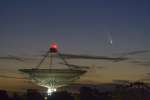 PanSTARRS over Parkes
9.03.2013
Sweeping quickly through southern skies on March 5, Comet PanSTARRS (C/2011 L4) follows the Sun toward the western horizon in this twilight scene. In the foreground is Australia's CSIRO Parkes Radio Telescope, a 64 meter wide steerable dish that is no stranger to the space age exploration of comets.
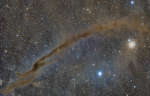 APOD: 2026 July 31 Б NGC 4372 and the Dark Doodad
30.07.2026
The Dark Doodad Nebula drifts through southern skies, a tantalizing target for binoculars toward the small constellation Musca, The Fly. A dusty interstellar cloud, it's seen against rich starfields just south of the Coalsack Nebula and the Southern Cross.
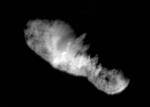 Comet Borrelly's Nucleus
26.09.2001
What does a comet nucleus look like? To answer this question, NASA controllers drove an aging probe through the hostile environs of a distant comet, expecting that even if comet fragments disabled the spacecraft, it would be worth the risk. The probe, Deep Space 1, survived.
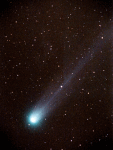 What are Comet Tails Made Of?
25.03.1996
The tail of comet Hyakutake, visible in this recent color image, is composed of dust and gas driven off the icy comet nucleus by the Sun's heat and blown away by the solar wind. Bathed in solar ultraviolet light, the gas molecules break down and are excited, producing a characteristic glow.
|
January February March April May June July August September |
|||||||||||||||||||||||||||||||||||||||||||||||||