
|
You entered: apod
 APOD: 2025 October 21 Б IC 1805: The Heart Nebula
21.10.2025
What electrifies the Heart Nebula? First, the large emission nebula on the left, catalogued as IC 1805, looks somewhat like a human heart. The nebula glows brightly in red light emitted by its most prominent element, hydrogen, but this long-exposure image was also blended with light emitted by sulfur (yellow) and oxygen (blue).
 APOD: 2025 November 12 Б A Super Lunar Corona
12.11.2025
What are those colorful rings around the Moon? A corona. Rings like this will sometimes appear when the Moon is seen through thin clouds. The effect is created by the diffraction of light around individual, similarly-sized water droplets in an intervening but mostly transparent cloud.
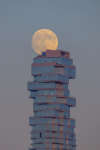 APOD: 2025 October 9 Б The Jenga Moon
9.10.2025
That big, bright, beautiful Full Moon you watched rise on the night of October 6 was the Harvest Moon. Famed in festival, story, and song, Harvest Moon is just the traditional name of the full moon nearest the time of the northern hemisphere's autumnal equinox. According to lore the name is a fitting one.
 APOD: 2025 October 20 Б Finding Comet Lemmon
20.10.2025
Tonight, if you can see the stars of the Big Dipper, then you can find comet Lemmon in your evening sky. After sunset, look for the faint but extended comet above your northwestern horizon -- but below the handle of the famous celestial kitchen utensil of the north.
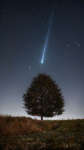 APOD: 2025 October 13 Б Lemmon Tree
13.10.2025
The tree is not in danger. That's because the comet pictured just above it, Comet C/2025 A6 (Lemmon), is far in the distance, well away from the Earth. Comet Lemmon now continues...
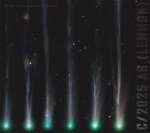 APOD: 2025 October 6 Б The Changing Ion Tail of Comet Lemmon
6.10.2025
How does a comet tail change? It depends on the comet. The ion tail of Comet C/2025 A6 (Lemmon) has been changing markedly, as detailed in the featured image sequenced over six days between September 25 and October 4 (left to right) from Texas, USA.
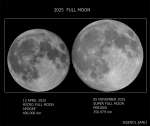 APOD: 2025 November 10 Б Micro Moon vs Super Moon
10.11.2025
What was so super about Wednesday's supermoon? Last week, a full moon occurred that appeared slightly larger and brighter than usual. The reason is that the Moon's fully illuminated phase occurred within a short time from perigee - when the Moon was its closest to the Earth in its elliptical orbit.
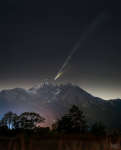 APOD: 2025 November 4 Б Comet Lemmon Beyond Lomnickц Peak
4.11.2025
Comet Lemmon has been putting on a show for cameras around the globe. Passing nearest to Earth in late October, the photogenic comet C/2025 A6 (Lemmon) sprouted two long and picturesque tails: a blue ion tail and a white dust tail.
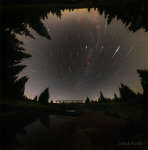 APOD: 2026 August 18 Б Perseids from Perseus
18.08.2026
This was a good year for the Perseids meteor shower. A key reason was the Moon was absent from lighting up Earth's night sky so that more meteors were visible than usual. Where was the Moon? It was busy visiting the Sun.
 APOD: 2025 October 28 Б NGC 6995: The Bat Nebula
28.10.2025
Can you see the bat? It haunts this cosmic close-up of the eastern Veil Nebula. The Veil Nebula itself is a large supernova remnant, the expanding debris cloud from the death explosion of a massive star.
|
January February March April May June July August September |
|||||||||||||||||||||||||||||||||||||||||||||||||