
|
You entered: Voyager 2
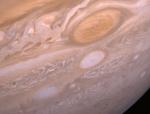 Giant Storm Systems Battle on Jupiter
5.02.2002
Two of the largest storm systems on Jupiter are colliding, and nobody is sure what will result. The larger storm is the famous Great Red Spot, while the smaller is a large white oval. Both are swirling cloud systems that circulate on Jupiter.
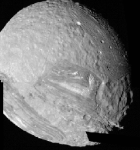 Uranus' Moon Miranda
24.12.1995
NASA's robot spacecraft Voyager 2 passed the planet Uranus and its moons in 1986. While the cloud tops of Uranus proved to be rather featureless, the surface of Miranda, the innermost of Uranus' large moons, showed several interesting features.
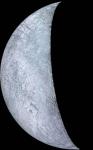 Crescent Europa
25.02.2002
Although the phase of this moon might appear familiar, the moon itself might not. In fact, this crescent shows part of Jupiter's moon Europa. The passing robot spacecraft Voyager 2 captured this image in 1979.
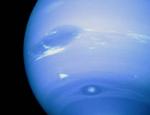 Dark Spots on Neptune
21.08.2001
Neptune has spots. The Solar System's outermost gas giant shows a nearly uniform blue hue created by small amounts of methane drifting in a thick atmosphere of nearly colorless hydrogen and helium. Dark spots do appear, however, that are anti-cyclones: large high-pressure systems that swirl in Neptune's cold cloud tops.
 Neptune: Big Blue Giant
21.02.1998
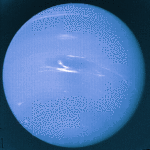
This picture was taken by the Voyager 2 spacecraft in 1989 - the only spacecraft ever to visit Neptune. Neptune will be the farthest planet from the Sun until 1999, when the elliptical orbit of Pluto will cause it to once again resume this status.
 Hamlet of Oberon
31.01.1998
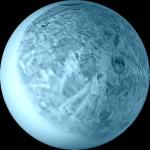
What's in a name? Since 1919, the International Astronomical Union has been charged with the task of establishing "conventional" nomenclature for planets, satellites, and surface features. For the remote Uranian system of moons, namesakes from Shakespearean works have been chosen.
 Hamlet of Oberon
27.02.1999
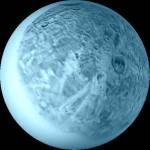
What's in a name? Since 1919, the International Astronomical Union has been charged with the task of establishing "conventional" nomenclature for planets, satellites, and surface features. For the remote Uranian system of moons, namesakes from Shakespearean works have been chosen.
 APOD: 2026 February 9 Б Miranda Revisited
9.02.2026
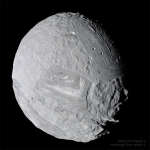
What is Miranda really like? Visually, old images from NASA's Voyager 2 have been recently combined and remastered to result in the featured image of Uranus's 500-kilometer-wide moon. In the late 1980s...
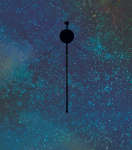 Interstellar Voyager
9.09.2022
Voyager 1 and Voyager 2 were launched in 1977 on a grand tour of the outer planets of the Solar System. They have become the longest operating and most distant spacecraft from Earth. Both have traveled beyond the heliosphere, the realm defined by the influence of the solar wind and the Sun's magnetic field.
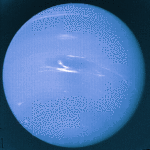 Neptune: Big Blue Giant
17.08.1995
This picture was taken by the Voyager 2 spacecraft in 1986 - the only spacecraft ever to visit Neptune. Neptune will be the farthest planet from the Sun until 1999, when the elliptical orbit of Pluto will cause it to once again resume this status.
|
January February March April May June July August September |
|||||||||||||||||||||||||||||||||||||||||||||||||