
|
You entered: Sagittarius Dwarf
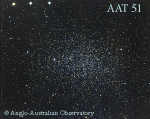 Nearby Dwarf Galaxy Leo I
19.05.1996
Leo I is a dwarf spheroidal galaxy in the Local Group of galaxies dominated by our Milky Way Galaxy and M31. Leo I is thought to be the most distant of the eleven known small satellite galaxies orbiting our Milky Way Galaxy.
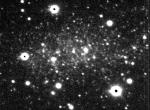 The Aquarius Dwarf
27.07.2003
Our Milky Way Galaxy is not alone. It is part of a gathering of about 50 galaxies known as the Local Group. Members include the Great Andromeda Galaxy (M31), M32, M33, the Large Magellanic Cloud, the Small Magellanic Cloud, Dwingeloo 1, several small irregular galaxies, and many dwarf elliptical and dwarf spheroidal galaxies.
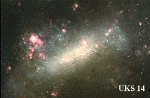 The Large Cloud Of Magellan (LMC)
24.01.1998
Ferdinand Magellan and his crew had plenty of time to study the southern sky during their famous voyage around the world. As a result, two fuzzy cloud-like objects, not visible to northern hemisphere dwellers, are now known as the Clouds of Magellan.
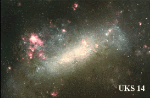 The Large Cloud of Magellan (LMC)
23.10.1996
Magellan and his crew had plenty of time to study the southern sky during their famous voyage around the world. As a result, two fuzzy cloud like objects in the southern sky are now known as the Clouds of Magellan. These star clouds are small irregular galaxies, satellites of our larger Milky Way spiral galaxy.
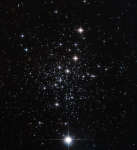 Palomar 12
18.02.2015
Palomar 12 was not born here. The stars of the globular cluster, first identified in the Palomar Sky Survey, are younger than those in other globular star clusters that roam the halo of our Milky Way Galaxy.
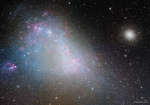 The Small Cloud of Magellan
5.01.2021
What is the Small Magellanic Cloud? It has turned out to be a galaxy. People who have wondered about this little fuzzy patch in the southern sky included Portuguese navigator Ferdinand Magellan...
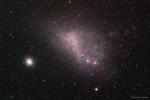 APOD: 2007 October 1- The Small Cloud of Magellan
1.10.2007
Portuguese navigator Ferdinand Magellan and his crew had plenty of time to study the southern sky during the first circumnavigation of planet Earth. As a result, two celestial wonders easily visible for southern hemisphere skygazers are known as the Clouds of Magellan.
 The Small Cloud of Magellan
3.09.2010
Portuguese navigator Ferdinand Magellan and his crew had plenty of time to study the southern sky during the first circumnavigation of planet Earth. As a result, two celestial wonders easily visible for southern hemisphere skygazers are known as the Clouds of Magellan.
 NGC 2419: Intergalactic Wanderer
13.04.2023
Stars of the globular cluster NGC 2419 are packed into this Hubble Space Telescope field of view toward the mostly stealthy constellation Lynx. The two brighter spiky stars near the edge of the frame are within our own galaxy. NGC 2419 itself is remote though, some 300,000 light-years away.
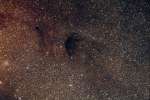 Dim World, Dark Nebula
8.07.2010
Dim, distant, dwarf planet Pluto can be hard to spot, especially in recent months as it wanders through the crowded starfields of Sagittarius and the central Milky Way. But fortunately for backyard Pluto hunters, it crossed in front of a dark nebula in early July.
|
January February March April May June July August |
||||||||||||||||||||||||||||||||||||||||||||||||||||||||