
|
You entered: Paranal Observatory
 Attack of the Laser Guide Stars
18.05.2018
Dodging powerful laser beams, a drone captured this stunning aerial view. The confrontation took place above the 8.2 meter diameter Very Large Telescopes of the Paranal Observatory on planet Earth. Firing during a test...
 Galaxy in a Crystal Ball
22.06.2018
A small crystal ball seems to hold a whole galaxy in this creative snapshot. Of course, the galaxy is our own Milky Way. Its luminous central bulge marked by rifts of interstellar dust spans thousands of light-years. On this long southern hemisphere night it filled dark Chilean skies over Paranal Observatory.
 Paranal Moonset
4.11.2006
Just before the rising Sun fully illuminated the 2,635 meter summit of Cerro Paranal in northern Chile, Gordon Gillet captured this stunning moonset. In the telephoto picture, a nearly full October Moon is silhouetting the impressive array of telescopes at ESO's Paranal Observatory.
 Sirius, Sun, Moon, and Southern Cross
7.07.2000
From left to right are the enclosures of Yepun (ye-poon; Sirius), Antu (an-too; Sun), Kueyen (qua-yen; Moon), and Melipal (me-li-pal; Southern Cross), pictured here as night falls at Paranal Observatory in northern Chile. These are the four 8.2 meter wide telescope units of the European Southern Observatory's Very Large Telescope (VLT).
 Comet G3 ATLAS: a Tail and a Telescope
24.01.2025
Comet C/2024 G3 ATLAS has made a dramatic appearance in planet Earth's skies. A visitor from the distant Oort Cloud, the comet reached its perihelion on January 13. On January 19, the bright comet was captured here from ESO Paranal Observatory in the Atacama desert in Chile.
 Wolf Lundmark Melotte
19.05.2017
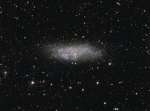
Named for the three astronomers instrumental in its discovery and identification, Wolf - Lundmark - Melotte (WLM) is a lonely dwarf galaxy. Seen toward the mostly southern constellation Cetus, about 3 million light-years from the Milky Way, it is one of the most remote members of our local galaxy group.
 Wolf-Lundmark-Melotte
7.04.2016
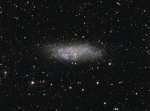
Named for the three astronomers instrumental in its discovery and identification, Wolf - Lundmark - Melotte (WLM) is a lonely dwarf galaxy. Seen toward the mostly southern constellation Cetus, about 3 million light-years from the Milky Way, it is one of the most remote members of our local galaxy group.
 The Fornax Cluster of Galaxies
11.06.2016
Named for the southern constellation toward which most of its galaxies can be found, the Fornax Cluster is one of the closest clusters of galaxies. About 62 million light-years away, it is almost...
 Comet Lovejoy over Paranal
28.12.2011
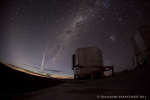
Comet Lovejoy (C/2011 W3) survived its close encounter with the Sun earlier this month, taking its place among wonders of the southern skies just in time for Christmas. Seen here before sunrise from Paranal Observatory in Chile, the sungrazing comet's tails stretch far above the eastern horizon.
 Zodiacal Light and the False Dawn
25.09.2007
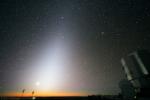
An unusual triangle of light will be particularly bright near the eastern horizon before sunrise during the next two months for observers in Earth's northern hemisphere. Once considered a false dawn, this triangle of light is actually Zodiacal Light, light reflected from interplanetary dust particles.
|
January February March April May June July August September |
|||||||||||||||||||||||||||||||||||||||||||||||||