
|
You entered: Near Earth Objects
 A Year of Assessing Astronomical Hazards
31.12.2002
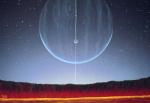
Could an asteroid destroy civilization on Earth? Mountain-sized space rocks could potentially impact the Earth causing global effects, and perhaps even be mistaken for a nuclear blast of terrestrial origin. Such large impacts are rare but have happened before. Modern telescopes have therefore begun to scan the skies for signs of approaching celestial hazards.
 Asteroids
13.03.1998
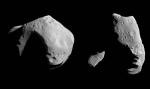
No asteroid or comet is known to be on a collision course with Earth. The asteroid designated 1997 XF11 had been predicted to come uncomfortably close, but new estimates place its passing beyond the orbit of the Moon. This earth-approaching asteroid was discovered by SpaceWatch astronomer Jim Scotti in December of last year.
 Eros From Orbit
16.02.2000
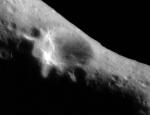
On February 14th, the NEAR spacecraft became the first artificial moon of an asteroid. Captured by the gentle gravity of a 20 mile long slipper-shaped mountain of rock, NEAR recorded this premier image while orbiting asteroid 433 Eros at a distance of about 200 miles.
800px.preview.jpg) 2023 CX1 Meteor Flash
2023 CX1 Meteor Flash
17.02.2023
While scanning the skies for near earth objects Hungarian astronomer Krisztiцn Sцrneczky first imaged the meter-sized space rock now cataloged as 2023 CX1 on 12 February 2023 at 20:18:07 UTC. That was about 7 hours before it impacted planet Earth's atmosphere.
 Periodic Comet Swift-Tuttle
19.02.1996
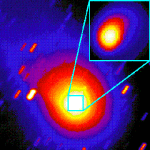
Comet Swift-Tuttle, shown above in false color, is the largest object known to make repeated passes near the Earth. It is also one of the oldest known periodic comets with sightings spanning two millennia.
 APOD: 2024 March 11 Б A Full Plankton Moon
11.03.2024
What glows in the night? This night featured a combination of usual and unusual glows. Perhaps the most usual glow was from the Moon, a potentially familiar object. The full Moon's nearly vertical descent results from the observer being near Earth's equator.
 Asteroids in the Distance
16.03.1998
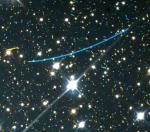
Rocks from space hit Earth every day. The larger the rock, though, the less often Earth is struck. Many kilograms of space dust pitter to Earth daily. Larger bits appear initially as a bright meteor. Baseball-sized rocks and ice-balls streak through our atmosphere daily, most evaporating quickly to nothing.
 Saturn at Equinox
30.09.2009
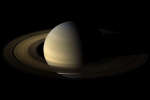
How would Saturn look if its ring plane pointed right at the Sun? Before last month, nobody knew. Every 15 years, as seen from Earth, Saturn's rings point toward the Earth and appear to disappear.
 Shuttle Over Earth
17.04.2022
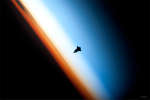
What's that approaching? Astronauts on board the International Space Station in 2010 first saw it far in the distance. Soon it enlarged to become a dark silhouette. As it came even closer, the silhouette appeared to be a spaceship.
 Dark Shuttle Approaching
16.02.2010
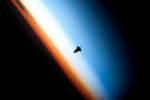
What's that approaching? Astronauts on board the International Space Station first saw it far in the distance. Soon it enlarged to become a dark silhouette. As it came even closer, the silhouette appeared to be a spaceship.
|
January February March April May June July August September October |
|||||||||||||||||||||||||||||||||||||||||||||||||