
|
You entered: Mariner 10
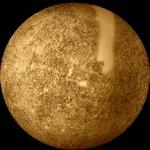 Mariner's Mercury
17.12.1996
Mercury, the closest planet to the Sun, remains the most mysterious of the Solar System's inner planets. Hiding in the Sun's glare it is a difficult target for Earth bound observers.
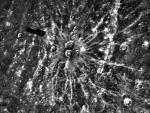 Degas Ray Crater on Mercury
16.12.2000
Like the Earth's Moon, Mercury is scarred with craters testifying to an intense bombardment during the early history of the Solar System. In 1974, the Mariner 10 spacecraft surveyed this innermost planet up close, producing the only detailed images of its tortured surface.
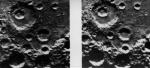 Mercury in Stereo: Craters Within Craters
12.01.1997
This Stereo image pair of craters on on Mercury was produced using data from NASA's robot explorer Mariner 10 which performed three close flybys of the Sun's closest companion, two in 1974 and one in 1975. However, the spacecraft was not equipped with a Stereo camera!
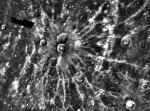 Degas Ray Crater on Mercury
8.12.1996
Like the Earth's Moon, Mercury is scarred with craters, testifying to an intense bombardment during the early history of the Solar System. In 1974, the Mariner 10 spacecraft surveyed this innermost planet up close, producing the only detailed images of its tortured surface.
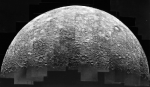 Mercury: A Cratered Inferno
12.09.1996
Mercury's surface looks similar to our Moon's. Each is heavily cratered and made of rock. Mercury's diameter is about 4800 km, while the Moon's is slightly less at about 3500 km (compared with about 12,700 km for the Earth). But Mercury is unique in many ways.
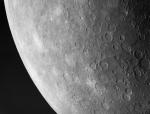 Southwest Mercury
16.02.2003
The planet Mercury resembles a moon. Mercury's old surface is heavily cratered like many moons. Mercury is larger than most moons but smaller than Jupiter's moon Ganymede and Saturn's moon Titan. Mercury is much denser and more massive than any moon, though, because it is made mostly of iron.
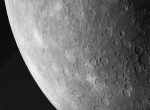 Southwest Mercury
13.02.2000
The planet Mercury resembles a moon. Mercury's old surface is heavily cratered like many moons. Mercury is larger than most moons but smaller than Jupiter's moon Ganymede and Saturn's moon Titan. Mercury is much denser and more massive than any moon, though, because it is made mostly of iron.
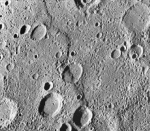 Mercury's Faults
21.01.1996
The surface of the planet Mercury is not without fault. In this case, however, "fault" refers to unusual surface features that are the topic of much speculation. The above fault line is called Santa Maria Rupes, and runs through many prominent craters.
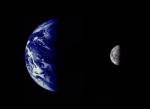 The Earth and Moon Planetary System
15.10.2001
How similar in size are the Earth and the Moon? A dramatic visual answer to this question is found by combining photographs taken by the Mariner 10 spacecraft that headed out toward Venus and Mercury in 1973.
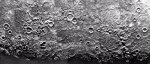 Mercury's Caloris Basin
20.01.1996
Mercury, the closest planet to the Sun, has a surface with so many craters it resembles the Earth's Moon. The largest surface feature on Mercury is the Caloris Basin, which resulted from a collision with an asteroid.
|
January February March April May June July August |
||||||||||||||||||||||||||||||||||||||||||||||||||||||||