
|
You entered: M 1
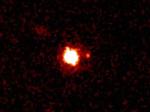 Eris: The Largest Known Dwarf Planet
18.09.2006
Is Pluto the largest dwarf planet? No! Currently, the largest known dwarf planet is (136199) Eris, renamed last week from 2003 UB313. Eris is just slightly larger than Pluto, but orbits as far as twice Pluto's distance from the Sun.
 The Horsehead Nebula
26.12.2017
One of the most identifiable nebulae in the sky, the Horsehead Nebula in Orion, is part of a large, dark, molecular cloud. Also known as Barnard 33, the unusual shape was first discovered on a photographic plate in the late 1800s.
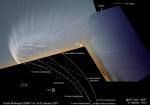 A Tail of Two Hemispheres
31.01.2007
By January 19/20 Comet McNaught's magnificent dust tail stretched for about 150 million kilometers (~1 AU), requiring images from both southern and northern hemispheres of planet Earth to take it all in.
 APOD: 2025 September 1 Б Callisto: Dirty Battered Iceball
31.08.2025
Its surface is the most densely cratered in the Solar System -- but what's inside? Jupiter's moon Callisto is a battered ball of dirty ice that is larger than the planet Mercury.
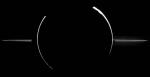 Jupiters Rings Revealed
16.09.1998
Why does Jupiter have rings? Jupiter's rings were discovered in 1979 by the passing Voyager 1 spacecraft, but their origin has always been a mystery. Recent data from the Galileo spacecraft currently orbiting Jupiter now confirms that these rings were created by meteoroid impacts on small nearby moons.
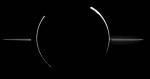 Jupiters Rings Revealed
16.06.2002
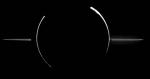
Why does Jupiter have rings? Jupiter's rings were discovered in 1979 by the passing Voyager 1 spacecraft, but their origin was a mystery. Data from the Galileo spacecraft currently orbiting Jupiter later confirmed that these rings were created by meteoroid impacts on small nearby moons.
 Jupiters Rings Revealed
8.01.2005
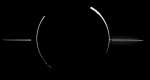
Why does Jupiter have rings? Jupiter's rings were discovered in 1979 by the passing Voyager 1 spacecraft, but their origin was a mystery. Data from the Galileo spacecraft that orbited Jupiter from 1995 to 2003 later confirmed that these rings were created by meteoroid impacts on small nearby moons.
 Jupiters Rings Revealed
17.06.2012
Why does Jupiter have rings? Jupiter's rings were discovered in 1979 by the passing Voyager 1 spacecraft, but their origin was a mystery. Data from the Galileo spacecraft that orbited Jupiter from 1995 to 2003 later confirmed that these rings were created by meteoroid impacts on small nearby moons.
 The X Ray Sky from eROSITA
22.06.2020
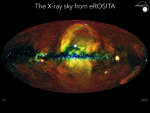
What if you could see X-rays? The night sky would seem a strange and unfamiliar place. X-rays are about 1,000 times more energetic than visible light photons and are produced by violent explosions and high temperature astronomical environments.
 The Vela Pulsar s Dynamic Jet
3.07.2003
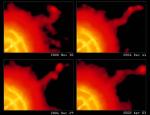
The Vela pulsar is a neutron star born over 10,000 years ago in a massive supernova explosion. Above, false-color x-ray images from the Chandra Observatory reveal details of this remnant pulsar's x-ray bright nebula along with emission from a spectacular jet of high-energy particles.
|
January February March April May June July August September |
|||||||||||||||||||||||||||||||||||||||||||||||||