
|
You entered: ISS
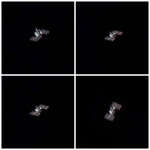 ISS from Wallasey
6.04.2019
After sunset on March 28, the International Space Station climbed above the western horizon, as seen from Wallasey, England at the mouth of the River Mersey. Still glinting in the sunlight some 400 kilometers...
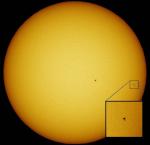 ISS and Discovery Transit the Sun
29.07.2005
That large sunspot near the right edge of the Sun is actually not a sunspot at all. It's the International Space Station (ISS) docked with the Space Shuttle Discovery on mission STS-114.
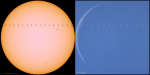 Sun and Moon and ISS
3.09.2022
On August 25 Sun and Moon could both be seen in planet Earth's daytime skies. And so could the International Space Station. The ISS crossed the disk of the waning crescent Moon as seen from Shunyi district, Beijing, China at about 11:02 am local time.
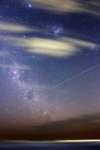 ISS and the Summer Milky Way
24.01.2013
Clouds on a summer night frame this sea and skyscape, recorded earlier this month near Buenos Aires, Argentina. But planet Earth's clouds are not the only clouds on the scene. Starry clouds...
 The ISS and a Colorful Moon
31.07.2015
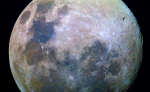
Tonight's Full Moon, the second Full Moon in July, could be called a blue moon according to modern folklore. But this sharp and detailed mosaic, recorded with telescope and digital camera just before July's first Full Moon, actually does show a colorful lunar surface.
 ISS and Mercury Too
13.05.2016
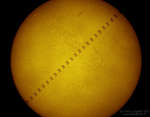
Transits of Mercury are relatively rare. Monday's leisurely 7.5 hour long event was only the 2nd of 14 Mercury transits in the 21st century. If you're willing to travel, transits of the International Space Station can be more frequent though, and much quicker.
 Moon over ISS
6.11.2020
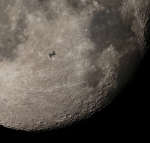
Completing one orbit of our fair planet in 90 minutes the International Space Station can easily be spotted by eye as a very bright star moving through the night sky. Have you seen it? The next time you do, you will have recognized the location of over 20 years of continuous human presence in space.
 ISS: Sunlight to Shadow
28.02.2008
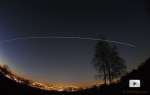
Orbiting 400,000 kilometers above the Earth, the Moon slid into Earth's shadow to begin last week's total lunar eclipse. Of course the International Space Station (ISS) slides into Earth's shadow every 90 minutes, the time it takes it to complete one orbit at an altitude of about 400 kilometers.
 APOD: 2026 April 15 Б The ISS Transits the Moon
15.04.2026
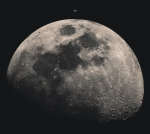
Nope, that is not an alien spaceship landing on the Moon! This is an image of the International Space Station (ISS) as it begins to transit in front of the Moon. The ISS is in low-Earth orbit (LEO) where it wizzes around the Earth every 90 minutes.
 ISS and Astronaut
10.04.2009
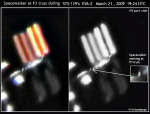
These two frames, taken with a video camera and a telescope, reveal remarkable details of the International Space Station (ISS) orbiting some 350 kilometers above planet Earth. Recorded during last month's visit...
|
January February March April May June July August |
||||||||||||||||||||||||||||||||||||||||||||||||||||||||