
|
You entered: Dione
 Dione and Rhea Ring Transit
22.11.2025
Seen to the left of Saturn's banded planetary disk, small icy moons Dione and Rhea are caught passing in front of the gas giant's extensive ring system in this sharp telescopic snapshot. The remarkable image was recorded on November 20, when Saturn's rings were nearly edge-on when viewed from planet Earth.
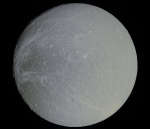 Saturns Moon Dione in Slight Color
5.11.2012
Why does one half of Dione have more craters than the other? Start with the fact that Saturn's moon Dione has one side that always faces Saturn, and one side that always faces away. This is similar to Earth's Moon.
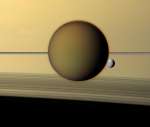 Ringside with Titan and Dione
5.01.2012
Orbiting in the plane of Saturn's rings, Saturnian moons have a perpetual ringside view of the gorgeous gas giant planet. Of course, while passing near the ring plane the Cassini spacecraft also shares their stunning perspective.
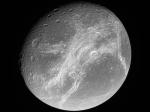 Bright Cliffs Across Saturns Moon Dione
5.09.2006
What causes the bright streaks on Dione? Recent images of this unusual moon by the robot Cassini spacecraft now orbiting Saturn are helping to crack the mystery. Close inspection of Dione's trailing hemisphere, pictured above, indicates that the white wisps are composed of deep ice cliffs dropping hundreds of meters.
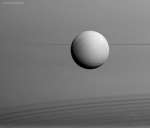 Dione, Rings, Shadows, Saturn
24.08.2015
What's happening in this strange juxtaposition of moon and planet? First and foremost, Saturn's moon Dione was captured here in a dramatic panorama by the robotic Cassini spacecraft currently orbiting the giant planet. The bright and cratered moon itself spans about 1100-km, with the large multi-ringed crater Evander visible on the lower right.
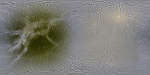 The Map of Dione
6.11.2014
This cylindrical projection global map is one of six new color maps of Saturn's midsized icy moons, constructed using 10 years of image data from the Cassini spacecraft. Discovered by Cassini (the astronomer) in 1684, Dione is about 1,120 kilometers across.
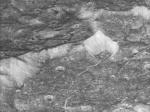 4500 Kilometers Above Dione
26.10.2005
What does the surface of Saturn's moon Dione look like? To find out, the robot Cassini spacecraft currently orbiting Saturn flew right past the fourth largest moon of the giant planet earlier this month. Pictured above is an image taken about 4,500 kilometers above Dione's icy surface, spanning about 23 kilometers.
 Stereo Helene
1.06.2024
Get out your red/blue glasses and float next to Helene, small, icy moon of Saturn. Appropriately named, Helene is a Trojan moon, so called because it orbits at a Lagrange point. A Lagrange point is a gravitationally stable position near two massive bodies, in this case Saturn and larger moon Dione.
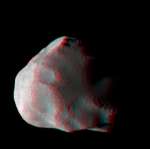 Stereo Helene
29.03.2025
Get out your red/blue glasses and float next to Helene, small, icy moon of Saturn. Appropriately named, Helene is a Trojan moon, so called because it orbits at a Lagrange point. A Lagrange point is a gravitationally stable position near two massive bodies, in this case Saturn and larger moon Dione.
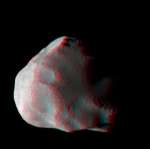 Stereo Helene
15.06.2019
Get out your red/blue glasses and float next to Helene, small, icy moon of Saturn. Appropriately named, Helene is one of four known Trojan moons, so called because it orbits at a Lagrange point. A Lagrange point is a gravitationally stable position near two massive bodies, in this case Saturn and larger moon Dione.
|
January February March April May June July August September |
|||||||||||||||||||||||||||||||||||||||||||||||||