
|
You entered: Barnard
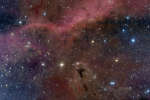 Dark Nebula LDN 1622 and Barnards Loop
6.04.2017
The silhouette of an intriguing dark nebula inhabits this cosmic scene. Lynds' Dark Nebula (LDN) 1622 appears below center against a faint background of glowing hydrogen gas only easily seen in long telescopic exposures of the region.
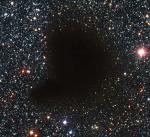 Molecular Cloud Barnard 68
11.05.1999
Where did all the stars go? What used to be considered a hole in the sky is now known to astronomers as a dark molecular cloud. Here, a high concentration of dust and molecular gas absorb practically all the visible light emitted from background stars.
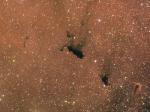 Molecular Cloud Barnard 163
21.03.2007
It may look to some like a duck, but it lays stars instead of eggs. In the center of the above image lies Barnard 163, a nebula of molecular gas and dust so thick that visible light can't shine through it.
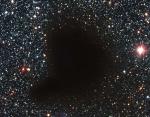 Molecular Cloud Barnard 68
2.02.2003
Where did all the stars go? What used to be considered a hole in the sky is now known to astronomers as a dark molecular cloud. Here, a high concentration of dust and molecular gas absorb practically all the visible light emitted from background stars.
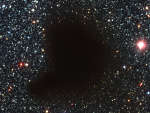 Molecular Cloud Barnard 68
23.03.2008
Where did all the stars go? What used to be considered a hole in the sky is now known to astronomers as a dark molecular cloud. Here, a high concentration of dust and molecular gas absorb practically all the visible light emitted from background stars.
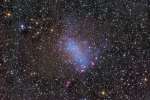 NGC 6822: Barnard s Galaxy
8.02.2013
Grand spiral galaxies often seem to get all the glory, flaunting their young, bright, blue star clusters in beautiful, symmetric spiral arms. But small galaxies form stars too, like nearby NGC 6822, also known as Barnard's Galaxy.
 IC 348 and Barnard 3
14.11.2024
A great nebulous region near bright star omicron Persei offers this study in cosmic contrasts. Captured in the telescopic frame the colorful complex of dust, gas, and stars spans about 3 degrees on the sky along the edge of the Perseus molecular cloud some 1000 light-years away.
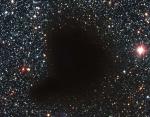 Molecular Cloud Barnard 68
19.12.2004
Where did all the stars go? What used to be considered a hole in the sky is now known to astronomers as a dark molecular cloud. Here, a high concentration of dust and molecular gas absorb practically all the visible light emitted from background stars.
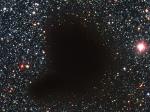 Molecular Cloud Barnard 68
9.04.2006
Where did all the stars go? What used to be considered a hole in the sky is now known to astronomers as a dark molecular cloud. Here, a high concentration of dust and molecular gas absorb practically all the visible light emitted from background stars.
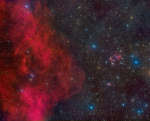 Barnard Stares at NGC 2170
19.01.2013
A gaze across a cosmic skyscape, this telescopic mosaic reveals the continuous beauty of things that are. The evocative scene spans some 6 degrees or 12 Full Moons in planet Earth's sky. At the left, folds of red, glowing gas are a small part of an immense, 300 light-year wide arc.
|
January February March April May June July August |
||||||||||||||||||||||||||||||||||||||||||||||||||||||||