
|
You entered: dark
 APOD: 2024 June 11 Б Colorful Stars and Clouds near Rho Ophiuchi
11.06.2024
Why is the sky near Antares and Rho Ophiuchi so colorful, yet dusty? The colors result from a mixture of objects and processes. Fine dust -- illuminated by starlight -- produces blue reflection nebulae. Gaseous clouds whose atoms are excited by ultraviolet starlight produce reddish emission nebulae. Backlit dust clouds block starlight and so appear dark.
 APOD: 2026 July 11 Б Messier 24: Sagittarius Star Cloud
11.07.2026
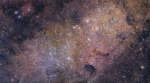
Unlike most entries in Charles Messier's famous catalog of deep sky objects, M24 is not a bright galaxy, star cluster, or nebula. It's a gap in nearby, obscuring interstellar dust clouds that allows a view of the distant stars in the Sagittarius spiral arm of our Milky Way galaxy.
 M57: The Ring Nebula
16.07.2000
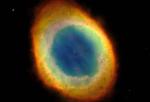
Except for the rings of Saturn, The Ring Nebula (M57) is probably the most famous celestial band. This planetary nebula's simple, graceful appearance is thought to be due to perspective -- our view from planet Earth looking straight into what is actually a barrel-shaped cloud of gas shrugged off by a dying central star.
 Eclipse in African Skies
22.06.2001
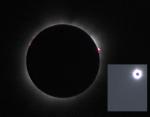
Yesterday, for a brief few minutes, a total eclipse of the Sun brought darkness to southern Africa's daytime skies. During this first total solar eclipse of the third millennium webcast sites were swamped, but sun-watchers along the eclipse path enjoyed clear weather and reported fantastic views.
 AE Aurigae: The Flaming Star
4.12.2001
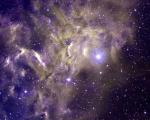
Is star AE Aurigae on fire? Although surrounded by what may look like smoke, the object known as the "flaming star" creates energy primarily by nuclear fusion, like other stars. Fire, typically defined...
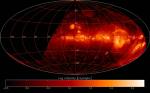 The Southern Sky in Warm Hydrogen
29.01.2002
A robotic telescope with red sunglasses in Chile has been photographing the entire southern sky for years. The result, shown above, is the most complete sky map of the most common visible light emitted from the most abundant element in our Galaxy: hydrogen. A very specific red color emitted by warm ionized hydrogen was observed.
 A Martian Metamorphosis
4.06.2002
Is it an Escher, or Mars? Three different types of surfaces visible in the North Polar Cap of Mars morph into each other in a way perhaps reminiscent of the works of M. C. Escher. On the far left dark sand covers the ground, while the center shows a transition to a dune field.
 Sol 4: Mars Color Panorama
9.07.1997
These mosaicked images form a color panorama of the region immediately surrounding the Sagan Memorial Station on Mars. The most recent images were recorded on Sol 4 - the 4th day of operations on the martian surface. The composite view reveals the reddish soil and rock-strewn terrain of an ancient martian flood channel.
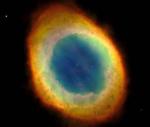 The Ring
7.01.1999
Except for the Rings of Saturn, The Ring Nebula (M57) is probably the most famous celestial band. This planetary nebula's simple, graceful appearance is thought to be due to perspective -- our view from planet Earth looking straight into what is actually a barrel-shaped cloud of gas shrugged off by a dying central star.
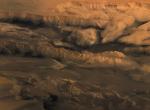 Melas, Candor, and Ophir: Valleys of Mariner
17.02.2005
First imaged by the Mariner 9 spacecraft, Valles Marineris, the grand canyon of Mars, is a system of enormous depressions or chasmas that stretch some 4,000 kilometers along the Martian equator. Looking north over the canyon's central regions, dark Melas Chasma lies in the foreground of this spectacular perspective view.
|
January February March April May June July August September |
|||||||||||||||||||||||||||||||||||||||||||||||||