
|
You entered: space
 APOD: 2025 September 8 Б IRAS 04302: Butterfly Disk Planet Formation
8.09.2025
This butterfly can hatch planets. The nebula fanning out from the star IRAS 04302+2247 may look like the wings of a butterfly, while the vertical brown stripe down the center may look like the butterfly's body -- but together they indicate an active planet-forming system.
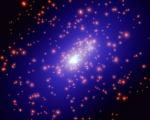 Dark Matter Map
14.08.2003
The total mass within giant galaxy cluster CL0025+1654, about 4.5 billion light-years away, produces a cosmic gravitational lens -- bending light as predicted by Einstein's theory of gravity and forming detectable images of even more distant background galaxies.
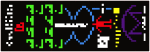 A Message from Earth
17.07.1997
What are these Earthlings trying to tell us? The above message was broadcast from Earth towards the globular star cluster M13 in 1974. During the dedication of the Arecibo Observatory - still the largest radio telescope in the world - a string of 1's and 0's representing the above diagram was sent.
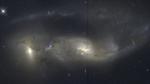 Arp 81: 100 Million Years Later
11.12.2003
From planet Earth, we view this strongly interacting pair of galaxies, cataloged as Arp 81, as they were only about 100 million years after their mutual closest approach. The havoc wreaked by gravity during...
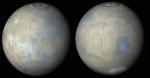 Mapping Mars
19.03.1999
This month, the Mars Global Surveyor (MGS) spacecraft began its primary mission to the red planet. Orbiting about once every two hours at an altitude of over 200 miles, instruments onboard MGS now regularly explore the Martian surface and atmosphere.
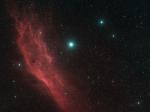 NGC 1499: The California Nebula
24.09.2006
What's California doing in space? Drifting through the Orion Arm of the spiral Milky Way Galaxy, this cosmic cloud by chance echoes the outline of California on the west coast of the United States.
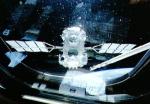 Compton Observatory In Orbit
8.04.2000
Nine years ago the massive Compton Gamma Ray Observatory was deployed in low earth orbit. Sparkling interior reflections and the bright limb of the Earth are visible in this 1991 window view of Compton's release by the crew of the Space Shuttle Atlantis.
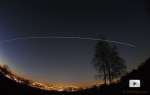 ISS: Sunlight to Shadow
28.02.2008
Orbiting 400,000 kilometers above the Earth, the Moon slid into Earth's shadow to begin last week's total lunar eclipse. Of course the International Space Station (ISS) slides into Earth's shadow every 90 minutes, the time it takes it to complete one orbit at an altitude of about 400 kilometers.
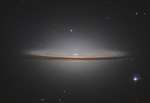 M104 Hubble Remix
8.03.2008
The striking spiral galaxy M104 is famous for its nearly edge-on profile featuring a broad ring of obscuring dust. Seen in silhouette against a bright bulge of stars, the swath of cosmic dust lanes lends a hat-like appearance to the galaxy in optical images suggesting the more popular moniker, The Sombrero Galaxy.
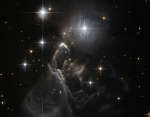 IRAS 05437 2502: An Enigmatic Star Cloud from Hubble
9.08.2010
What's lighting up nebula IRAS 05437+2502? No one is sure. Particularly enigmatic is the bright upside-down V that defines the upper edge of this floating mountain of interstellar dust, visible near the image center.
|
January February March April May June July August September |
|||||||||||||||||||||||||||||||||||||||||||||||||