
|
You entered: planets
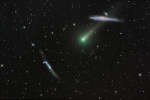 Comet Leonard and the Whale Galaxy
3.12.2021
Sweeping through northern predawn skies, on November 24 Comet Leonard (C/2021 A1) was caught between two galaxies in this composite telescopic image. Sporting a greenish coma the comet's dusty tail seems to harpoon the heart of NGC 4631 (top) also known as the Whale Galaxy.
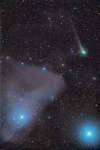 Stardust and Comet Tails
20.08.2022
Heading for its closest approach to the Sun, or perihelion, on December 19 comet C/2017 K2 (PanSTARRS) remains a sight for telescopic observers as it sweeps through planet Earth's skies in the constellation Scorpius.
 APOD: 2025 April 8 Б Moon Visits Sister Stars
8.04.2025
Sometimes, the Moon visits the Pleiades. Technically, this means that the orbit of our Moon takes it directly in front of the famous Pleiades star cluster, which is far in the distance. The technical...
 Deimos Before Sunrise
24.05.2025
Deimos takes 30 hours and 18 minutes to complete one orbit around the Red Planet. That's a little more than one Martian day or sol which is about 24 hours and 40 minutes long, so Deimos drifts westward across the Martian sky.
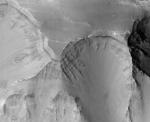 In A Grand Canyon On Mars
12.02.1998
In a grand canyon on Mars, steep slopes fall away from a smooth plateau revealing striking layered rock formations. The canyon is part of the Valles Marineris, a 2,500 mile long system of canyons cutting across the Martian equator.
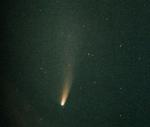 Comet NEAT in Southern Skies
6.03.2003
After last month's dramatic swoop past the Sun, Comet NEAT (C/2002 V1) appeared as a naked-eye comet, emerging from the evening twilight in planet Earth's southern skies. On March 1st, New Zealand...
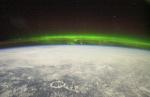 Aurora from Space
8.04.2003
What do auroras look like from space? From the ground, auroras dance high above clouds, frequently causing spectacular displays. The International Space Station (ISS) orbits just at the same height as many auroras, though. Therefore, sometimes it flies over them, but also sometimes it flies right through.
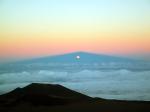 Moonrise Through Mauna Keas Shadow
3.12.2003
How can the Moon rise through a mountain? It cannot -- what was photographed here is a moonrise through the shadow of a large volcano. The volcano is Mauna Kea, Hawai'i, USA, a frequent spot for spectacular photographs since it is arguably the premier observing location on planet Earth.
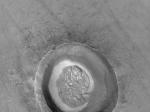 Brain Crater on Mars
19.05.2004
What caused this unusual looking crater floor on Mars? Appearing at first glance to resemble the human brain, the natural phenomena that created the unusual texture on the floor of this Martian impact crater are currently under investigation. The light colored region surrounding the brain-textured region is likely sand dunes sculpted by winds.
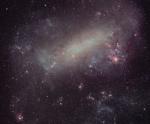 The Large Cloud of Magellan
2.09.2004
Portuguese navigator Fernando de Magellan and his crew had plenty of time to study the southern sky during the first circumnavigation of planet Earth. As a result, two fuzzy cloud-like objects easily visible for southern hemisphere skygazers are known as the Clouds of Magellan.
|
January February |
|||||||||||||||||||||||||||||||||||||||||||||||||