
|
You entered: outer Galaxy
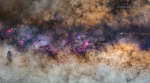 The Annotated Galactic Center
27.09.2019
The center of our Milky Way galaxy can be found some 26,000 light-years away toward the constellation Sagittarius. Even on a dark night, you can't really see it though. Gaze in that direction, and your sight-line is quickly obscured by intervening interstellar dust.
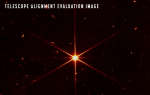 2MASS J17554042 6551277
19.03.2022
2MASS J17554042+6551277 doesn't exactly roll off the tongue but that's the name, a coordinate-based catalog designation, of the star centered in this sharp field of view. Fans of the distant universe should get used to its spiky appearance though.
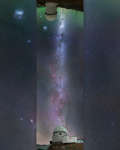 A 10 000 Kilometer Galactic Bridge
3.06.2022
With this creative astro-collaboration you can follow the plane of our Milky Way Galaxy as it bridges northern and southern hemisphere skies. To construct the expansive composite nightscape, skies over Observatorio El Sauce...
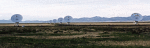 A Very Large Array of Radio Telescopes
27.07.1997
Pictured above is one of the world's premiere radio astronomical observatories: The Very Large Array (VLA). Each antenna dish is as big as a house (25 meters across) and mounted on railroad tracks. The VLA consists of 27 dishes - together capable of spanning the size of a city (35 kilometers).
 Name This Satellite
20.04.1998
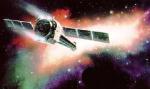
Can you name this satellite? In December, NASA's third Great Observatory is planned for launch. The two NASA Great Observatories currently in orbit are the Hubble Space Telescope and the Compton Gamma-Ray Observatory, both now named for famous scientists. But after whom should the Advanced X-ray Astrophysics Facility (AXAF) be named?
 James Webb Space Telescope over Earth
26.12.2021
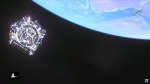
There's a big new telescope in space. This one, the James Webb Space Telescope (JWST), not only has a mirror over five times larger than Hubble's in area, but can see better in infrared light.
 Red Aurora Over Australia
1.02.2012
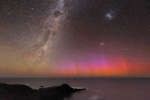
Why would the sky glow red? Aurora. Last week's solar storms, emanating mostly from active sunspot region 1402, showered particles on the Earth that excited oxygen atoms high in the Earth's atmosphere. As the excited element's electrons fell back to their ground state, they emitted a red glow.
 The Cosmic Web of the Tarantula Nebula
11.01.2011
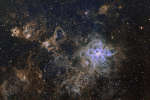
It is the largest and most complex star forming region in the entire galactic neighborhood. Located in the Large Magellanic Cloud, a small satellite galaxy orbiting our Milky Way galaxy, the region's spidery appearance is responsible for its popular name, the Tarantula nebula. This tarantula, however, is about 1,000 light-years across.
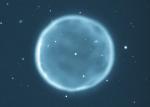 Spherical Planetary Nebula Abell 39
23.01.2001
One of the largest spheres in our Galaxy is giving valuable clues about the chemical composition of stars by its very shape. Planetary nebula Abell 39, now six light-years across, was once a sun-like star's outer atmosphere expelled thousands of years ago.
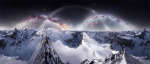 APOD: 2026 April 21 Б Three Sky Arches over Snowy Alps
21.04.2026
Why are there three arches across the sky instead of two? Last month, after being dropped off by a helicopter at a high mountain peak in the Alps near the Swiss Italian border, an adventurous astrophotographer expected two arches of our Milky Way galaxy to be visible during the night.
|
January February March April May June July August September |
|||||||||||||||||||||||||||||||||||||||||||||||||