
|
You entered: nearest stars
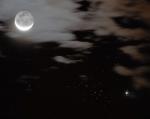 Jupiter, Moons, and Bees
25.09.2002
Rising before the Sun on September 4, Jupiter and an old cresent Moon gathered in the dim constellation of Cancer. Watching from a hillside near Austin, Texas, planet Earth, astrophotographer Russell Croman recorded this view of their passing as clouds gracefully dimmed the brilliant moonlight.
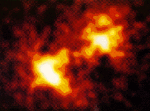 An X-ray Hot Supernova in M81
3.12.1995
In 1993, a star in the galaxy M81 exploded. Above is a picture of the hot material ejected by this supernova explosion. The picture was taken in X-rays with the Advanced Satellite for Cosmology and Astrophysics (ASCA).
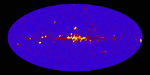 The X-Ray Sky
2.01.1996
What if you could see X-rays? If you could, the night sky would be a strange and unfamiliar place. X-rays are about 1,000 times more energetic than visible light photons and are produced in violent and high temperature astrophysical environments.
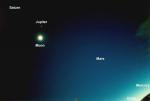 Sky and Planets
10.03.2000
On February 10th, an evocative evening sky above Rocklin, California, USA inspired astrophotographer Steve Sumner to record this remarkable sight - five planets and the Moon. Near its first quarter phase, the bright Moon...
 Moon, Mars, Venus, and Spica
4.12.2002
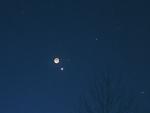
Gliding toward today's total eclipse of the Sun, the crescent Moon has been rising early, just before dawn. And as a prelude to its close solar alignment, the Moon also completed a lovely celestial triangle, closing with bright planets Mars and Venus on the morning of December 1.
 Electric Night
4.12.2019
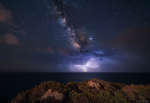
It may appear, at first, like the Galaxy is producing the lightning, but really it's the Earth. The featured nighttime landscape was taken from a southern tip of the Italian Island of Sardinia in early June.
 Sideways Galaxy NGC 3628
16.03.2011
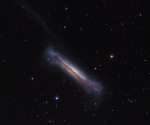
Dark dust lanes cut across the middle of this gorgeous island universe, a strong hint that NGC 3628 is a spiral galaxy seen sideways. About 35 million light-years away in the northern springtime constellation...
 Milky Way Auroral Flower
18.10.2022
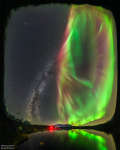
Could the stem of our Milky Way bloom into an auroral flower? No, not really, even though it may appear that way in todayБs featured all-sky image. On the left, the central plane of our home galaxy extends from the horizon past the middle of the sky.
 Spiral Galaxy NGC 300
21.08.2002
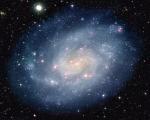
NGC 300 is so interesting because it is so normal. An Sc-type spiral galaxy in the nearby Sculptor group of galaxies, NGC 300 shows typical flowing blue spiral arms, an expected compact nucleus, and the requisite amount of stars, star clusters, and nebulae.
 Spiral Galaxy NGC 253 Almost Sideways
2.11.1996
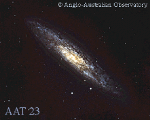
NGC 253 is a normal spiral galaxy seen here almost sideways. It is the largest member of the Sculptor Group of Galaxies, the nearest group to our own Local Group of Galaxies.
|
January February March April May June July August September October |
|||||||||||||||||||||||||||||||||||||||||||||||||