
|
You entered: dark
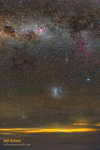 Southern Sky at 38,000 Feet
30.01.2021
Celestial sights of the southern sky shine above a cloudy planet Earth in this gorgeous night sky view. The scene was captured from an airliner's flight deck at 38,000 feet on a steady westbound ride to Lima, Peru.
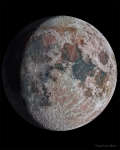 APOD: 2023 January 16 Б Moon Enhanced
16.01.2023
Our Moon doesn't really look like this. Earth's Moon, Luna, doesn't naturally show this rich texture, and its colors are more subtle. But this digital creation is based on reality. The featured image is a composite of multiple images and enhanced to bring up real surface features.
 3 ATs
3 ATs
4.05.2024
Despite their resemblance to R2D2, these three are not the droids you're looking for. Instead, the enclosures house 1.8 meter Auxiliary Telescopes (ATs) at Paranal Observatory in the Atacama Desert region of Chile.
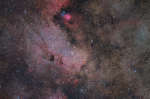 Messier 24: Sagittarius Star Cloud
18.07.2024
Unlike most entries in Charles Messier's famous catalog of deep sky objects, M24 is not a bright galaxy, star cluster, or nebula. It's a gap in nearby, obscuring interstellar dust clouds that allows a view of the distant stars in the Sagittarius spiral arm of our Milky Way galaxy.
 APOD: 2024 September 15 Б Find the Man in the Moon
15.09.2024
Have you ever seen the Man in the Moon? This common question plays on the ability of humans to see pareidolia -- imagining familiar icons where they don't actually exist. The textured surface...
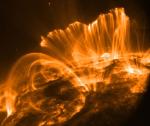 Coronal Rain, Solar Storm
15.11.2000
In this picture, the Sun's surface is quite dark. A frame from a movie recorded on November 9th by the orbiting TRACE telescope, it shows coronal loops lofted over a solar active region.
 Open Cluster NGC 6520 from CFHT
22.07.2002
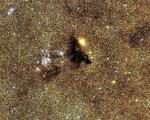
Did you ever have a day when it felt like a dark cloud was following you around? For the open cluster of stars NGC 6520, every day is like this. On the left of the above picture are many of NGC 6520's bright blue stars.
 A Rare Annular Venusian Solar Eclipse
15.06.2004
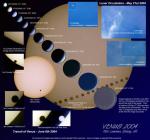
An unusual type of solar eclipse occurred last week. Usually it is the Earth's Moon that eclipses the Sun. Last week, for the first time in over 100 years, the planet Venus took a turn.
 Titan Through the Haze
26.10.2004
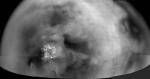
What are these surface features on Titan? This planet-sized moon of Saturn had much of its south polar surface imaged during an initial flyby by the Saturn-orbiting Cassini spacecraft back in early July.
 Tycho and Copernicus: Lunar Ray Craters
5.03.2005
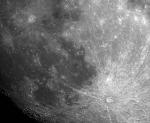
Dazzling in binoculars or a small telescope, the Moon is pocked with impact craters. During partial lunar phases, the craters along the terminator are cast in dramatic relief by strong shadows. But when the Moon is full some craters seem to sprout systems of bright radial lines or rays.
|
January February March April May June July August September |
|||||||||||||||||||||||||||||||||||||||||||||||||