
|
You entered: massive stars
 Small Star
5.06.1997
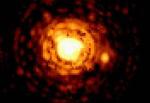
A dim double star system cataloged as Gliese 623 lies 25 light-years from Earth, in the constellation of Hercules. The individual stars of this binary system were distinguished for the first time when the Hubble Space Telescope's Faint Object Camera recorded this image in June 1994.
 APOD: 2026 July 24 Б RCW 86: Historical Supernova Remnant
24.07.2026
In 185 AD, Chinese astronomers recorded the appearance of a new star in the Nanmen asterism. That part of the sky is identified with part of the southern constellation Centaurus on modern star charts.
 Cataclysmic Dawn
10.01.2015
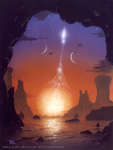
Will this dawn bring another nova? Such dilemmas might be pondered one day by future humans living on a planet orbiting a cataclysmic variable binary star system. Cataclysmic variables involve gas falling from a large star onto an accretion disk surrounding a massive but compact white dwarf star.
 Stars, Gas, and Dust Battle in the Carina Nebula
15.08.2017
Chaos reigns in the Carina Nebula where massive stars form and die. Striking and detailed, this close-up of a portion of the famous nebula is a combination of light emitted by hydrogen (shown in red) and oxygen (shown in blue).
 Dawn Before Nova
17.11.2009
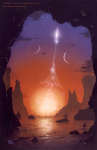
Will this dawn bring another nova? Such dilemmas might be pondered one day by future humans living on a planet orbiting a cataclysmic variable binary star system. Cataclysmic variables involve gas falling from a large star onto an accretion disk surrounding a massive but compact white dwarf star.
 Jets from SS433
13.04.1997
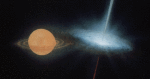
SS433 is one of the most exotic star systems known. Its unremarkable name stems from its inclusion in a catalog of stars which emit radiation characteristic of atomic hydrogen. Its very remarkable behavior stems from a compact object, a black hole or neutron star, which has produced an accretion disk with jets.
 Unusual Starburst Galaxy NGC 1313
30.03.2010
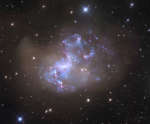
Why is this galaxy so discombobulated? Usually, galaxies this topsy-turvy result from a recent collision with a neighboring galaxy. Spiral galaxy NGC 1313, however, appears to be alone. Brightly lit with new and blue massive stars, star formation appears so rampant in NGC 1313 that it has been labeled a starburst galaxy.
 Star Forming Region S106
7.11.2011
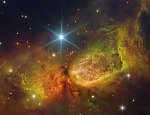
Massive star IRS 4 is beginning to spread its wings. Born only about 100,000 years ago, material streaming out from this newborn star has formed the nebula dubbed Sharpless 2-106 Nebula (S106), pictured above.
 Small Star
20.11.1999
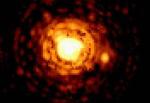
A dim double star system cataloged as Gliese 623 lies 25 light-years from Earth, in the constellation of Hercules. The individual stars of this binary system were distinguished for the first time when the Hubble Space Telescope's Faint Object Camera recorded this image in June 1994.
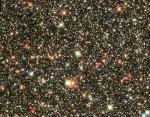 Sagittarius Star Cloud
20.05.2001
Stars come in all different colors. The color of a star indicates its surface temperature, an important property used to assign each star a spectral type. Most stars in the above Sagittarius Star Cloud are orange or red and relatively faint, as our Sun would appear.
|
January February March April May June July August September |
|||||||||||||||||||||||||||||||||||||||||||||||||