
|
You entered: magnetic field
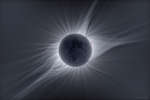 The Big Corona
20.09.2017
Most photographs don't adequately portray the magnificence of the Sun's corona. Seeing the corona first-hand during a total solar eclipse is unparalleled. The human eye can adapt to see coronal features and extent that average cameras usually cannot. Welcome, however, to the digital age.
 APOD: 2024 April 24 Б Dragons Egg Bipolar Emission Nebula
24.04.2024
How did a star form this beautiful nebula? In the middle of emission nebula NGC 6164 is an unusually massive star. The central star has been compared to an oyster's pearl and an egg protected by the mythical sky dragons of Ara.
 APOD: 2024 September 18 Б The Mermaid Nebula Supernova Remnant
18.09.2024
New stars are born from the remnants of dead stars. The gaseous remnant of the gravitational collapse and subsequent death of a very massive star in our Milky Way created the G296.5+10.0 supernova remnant, of which the featured Mermaid Nebula is part.
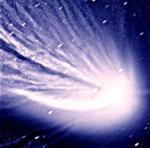 Detailing Hale-Bopp
8.05.1997
This enhanced composite image detailing structure in the coma and dust tail of Hale-Bopp was recorded May 5 - one day before the comet's passage from north to south across the plane of Earth's orbit.
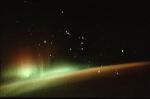 Aurora and Orion
20.03.1999
Looking toward the south from low Earth orbit, the crew of the Space Shuttle Endeavor made this stunning time exposure of the Aurora Australis or southern lights in April of 1994. Aurora are visible at high northern latitudes as well, with the northern lights known as Aurora Borealis.
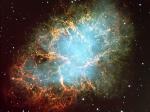 The Crab Nebula from VLT
22.11.1999
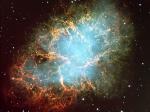
The Crab Nebula, filled with mysterious filaments, is the result of a star that was seen to explode in 1054 AD. This spectacular supernova explosion was recorded by Chinese and (quite probably) Anasazi Indian astronomers.
 The Crab Nebula from VLT
14.09.2003
The Crab Nebula, filled with mysterious filaments, is the result of a star that was seen to explode in 1054 AD. This spectacular supernova explosion was recorded by Chinese and (quite probably) Anasazi Indian astronomers.
 The Radio Sky: Tuned to 408MHz
5.02.2005
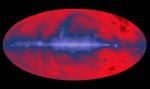
Tune your radio telescope to 408MHz (408 million cycles per second) and check out the Radio Sky! In the 1970s large dish antennas at three radio observatories, Jodrell Bank, MPIfR, and Parkes Observatory, were used to do just that - the data were combined to map the entire sky.
 Reinvigorated Sun and Prominence
23.03.2010
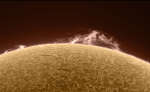
Dramatic prominences can sometimes be seen looming just beyond the edge of the sun. Such was the case last week as a giant prominence, visible above on the right, highlighted a Sun showing increased activity as it comes off an unusually quiet Solar Minimum.
 A Twisted Solar Eruptive Prominence
24.01.2015
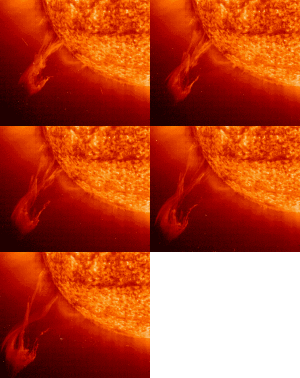
Ten Earths could easily fit in the "claw" of this seemingly solar monster. The monster, actually a huge eruptive prominence, is seen moving out from our Sun in this condensed half-hour time-lapse sequence. This large prominence, though, is significant not only for its size, but its shape.
|
January February March April May June July August September October |
|||||||||||||||||||||||||||||||||||||||||||||||||