
|
You entered: lunar surface
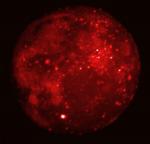 Eclipsed Moon in Infrared
10.01.1997
Last September's total lunar eclipse disappointed many observers in the Eastern and Midwestern US who were cursed with cloudy skies. However, the Midcourse Space Experiment (MSX) satellite had a spectacular view from Earth orbit and SPIRIT III, an onboard imaging infrared telescope, was used to repeatedly image the moon during the eclipse.
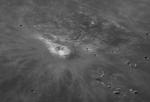 Aristarchus Plateau
30.11.2007
Anchored in the vast lava flows of the Moon's Oceanus Procellarum lies the Aristarchus Plateau. The bright impact crater at the corner of the plateau is Aristarchus, a young crater 42 kilometers wide and 3 kilometers deep. Only slightly smaller, lava flooded Herodotus crater is above and to the left.
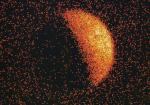 X Ray Moon
14.09.2002
This x-ray image of the Moon was made by the orbiting ROSAT (Röntgensatellit) Observatory in 1990. In this digital picture, pixel brightness corresponds to x-ray intensity. Consider the image in three parts: the bright hemisphere of the x-ray moon, the darker half of the moon, and the x-ray sky background.
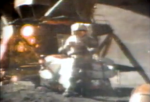 Hammer Versus Feather on the Moon
1.11.2011
If you drop a hammer and a feather together, which reaches the ground first? On the Earth, it's the hammer, but is the reason only because of air resistance? Scientists even before Galileo have pondered and tested this simple experiment and felt that without air resistance, all objects would fall the same way.
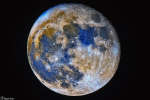 A Blue Moon in Exaggerated Colors
31.08.2021
The Moon is normally seen in subtle shades of grey or gold. But small, measurable color differences have been greatly exaggerated to make this telescopic, multicolored, moonscape captured during the Moon's full phase. The different colors are recognized to correspond to real differences in the chemical makeup of the lunar surface.
 APOD: 2024 January 24 Б Earth and Moon from Beyond
24.01.2024
What do the Earth and Moon look like from beyond the Moon? Although frequently photographed together, the familiar duo was captured with this unusual perspective in late 2022 by the robotic Orion spacecraft of NASA's Artemis I mission as it looped around Earth's most massive satellite and looked back toward its home world.
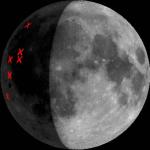 Moon Struck
8.12.2001
Craters produced by ancient impacts on the airless Moon have long been a familiar sight. But only since 1999 have observers seen elusive optical flashes on the lunar surface - likely explosions resulting from impacting meteoroids. These startling observations were made with modest telescopes and video equipment during the 1999 and 2001 Leonid meteor showers.
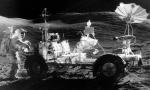 Apollo 17's Lunar Rover
1.07.1999
In December of 1972, Apollo 17 astronauts Eugene Cernan and Harrison Schmitt spent about 75 hours exploring the Moon's Taurus-Littrow valley while colleague Ronald Evans orbited overhead. Cernan and Schmitt were the last humans to walk or ride on the Moon - aided in their explorations by a Lunar Roving Vehicle.
 Apollo 11: Armstrong's Lunar Selfie
22.07.2023
A photograph of Buzz Aldrin standing on the Moon taken by Neil Armstrong, was digitally reversed to create this lunar selfie. Captured in July 1969 following the Apollo 11 moon landing, Armstrong's original photograph recorded not only the magnificent desolation of an unfamiliar world, but Armstrong himself reflected in Aldrin's curved visor.
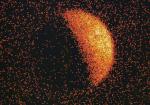 X Ray Moon
2.09.2000
This x-ray image of the Moon was made by the orbiting ROSAT (Röntgensatellit) Observatory in 1990. In this digital picture, pixel brightness corresponds to x-ray intensity. Consider the image in three parts: the bright hemisphere of the x-ray moon, the darker half of the moon, and the x-ray sky background.
|
January February March April May June July August September |
|||||||||||||||||||||||||||||||||||||||||||||||||