
|
You entered: galaxy formation
 APOD: 2024 February 20 Б AM1054: Stars Form as Galaxies Collide
19.02.2024
When galaxies collide, how many stars are born? For AM1054-325, featured here in a recently released image by the Hubble Space Telescope, the answer is millions. Instead of stars being destroyed as galaxy AM1054-325 and a nearby galaxy circle each other, their gravity and motion has ignited stellar creation.
 I Zwicky 18: The Case of the Aging Galaxy
17.10.2007
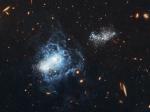
How old is this galaxy? The galaxy on the left, I Zwicky 18, was once thought to be one of the youngest galaxies on record since its bright stars indicated an age of only 500 million years.
 The Stars of NGC 1705
23.04.2003
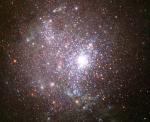
Some 2,000 light-years across, NGC 1705 is small as galaxies go, similar to our Milky Way's own satellite galaxies, the Magellanic Clouds. At a much larger distance of 17 million light-years...
 Galaxies Away
25.03.1998
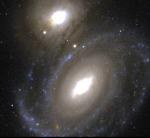
This striking pair of galaxies is far, far away ... about 350 million light-years from Earth. Cataloged as AM0500-620, the pair is located in the southern constellation Dorado. The background elliptical and foreground spiral galaxy are representative of two of the three major classes of galaxies which inhabit our Universe.
 Galaxies Away
21.08.1999
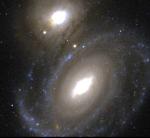
This striking pair of galaxies is far, far away ... about 350 million light-years from Earth. Cataloged as AM0500-620, the pair is located in the southern constellation Dorado. The background elliptical and foreground spiral galaxy are representative of two of the three major classes of galaxies which inhabit our Universe.
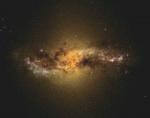 Arp 230: Two Spirals in One?
31.08.1997
Is this one galaxy or two? Analysis of Arp 230 has shown evidence that this seemingly single spiral galaxy is actually the result of the recent collision of two spiral galaxies. The slow motion collision took place over about 100 million years and induced a burst of star formation that has begun to subside.
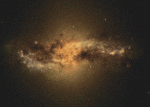 Arp 230: Two Spirals in One?
22.08.1996
Is this one galaxy or two? Analysis of Arp 230 has shown evidence that this seemingly single spiral galaxy is actually the result of the recent collision of two spiral galaxies. The slow motion collision took place over about 100 million years and induced a burst of star formation that has begun to subside.
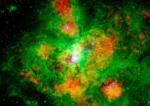 30 Doradus Across the Spectrum
23.12.1997
30 Doradus is lit up like a Christmas tree. Shining in light across the electromagnetic spectrum, 30 Doradus glows because of all the energetic processes that go on there. A distinctive region visible...
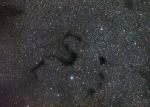 Snake in the Dark
21.05.2005
Dark nebulae snake across a gorgeous expanse of stars in this wide-field view toward the pronounceable constellation Ophiucus and the center of our Milky Way Galaxy. In fact, the central S-shape seen here is well known as the Snake Nebula.
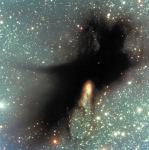 BHR 71: Stars, Clouds, and Jets
26.01.2003
What is happening to molecular cloud BHR 71? Quite possible, a binary star system is forming inside. Most stars in our Galaxy are part of binary star systems, but few have ever been seen in formation.
|
January February March April May June July August |
||||||||||||||||||||||||||||||||||||||||||||||||||||||||